Monday, May 07, 2007

Just finished talking in Bahasa

Just came back from Jakarta last Friday after launching the latest book of the Center for Media Freedom and Responsibility (CMFR) and attending the regional World Press Freedom Day activities there.

The book, launched in commemoration of World Press Freedom Day, is Philippine Press Freedom Primer: Quick Answers to Your Questions.

An easy reading material about the media situation in the Philippines, the primer is meant to provide those unfamiliar with the state of press freedom in the Philippines a quick guide to and overview of press conditions in the country. CMFR executive director Melinda Quintos de Jesus describes the primer as “designed to serve those making their first step of inquiry into the subject. It should be useful in planning research strategies for academic papers and as a quick reference for those writing articles and reports. For the general public, it is a ‘quick fix,’ a resource that will help contextualize current news about the press, from the violent attacks as well as the cases of libel which have caused journalists to be jailed.”

For more information about the primer, please click here.

I am currently writing an article about the World Press Freedom Day activities there in Jakarta, which I will later post here. It was great to see journalists around the region gathering together, taking a united stand for press freedom. Journalists as far as Afghanistan, Nepal, and Pakistan were also there in Jakarta to lend support.

It was also fun to see my old friends there -- like Siew Eng of the Southeast Asian Press Alliance (SEAPA) and Indonesian journalists Abdul Manan, Handaru Putro, and Anggara (If I am forgetting anyone, it was not intentional so please don't be sad.) I also made new friends there, so even though I was the only one from CMFR went to Jakarta and attend the activities, it was never that lonely. Plus I spent some time there with Filipino journalists Joe Torres (of the National Union of Journalists of the Philippines) and Red Batario (Center for Community Journalism and Development), two journalists I sincerely admire. These guys made me "celebrate" my birthday in Jakarta (photos at left) even though it's still a few months away, and told everyone that I am the Philippine Idol. Sheesh. Imagine my fright when the Indonesian and Afghan journalists I'm with in a karaoke club (on my last night before I left) began talking about my "Idol" stint and egging me to sing. Horror of horrors.

Thanks to these guys, my stay proved memorable. Of course, it helped that SEAPA provided me with a nice room at Santika Hotel. Nice facilities I must say (By the way, the first photo above was taken in my room).


Of course one section in my room is devoted to the infamous "green envelopes."


Anyone who has worked with CMFR for at least five hours will know that the green envelopes contain the gazillion work we do there. In my case:


Election monitors -- what else is new

Since I was CMFR's publicity person in Jakarta, I did not forget to bring copies of CMFR's publications, including the primer.


Also discovered the Indonesian versions of Chippy. Forgive my MSG-addicted taste buds, but the Filipino versions are waaay better.


The view outside my room:


Since there is no direct Manila-Jakarta flight, I have to stop by Singapore's Changi Airport. It was my first time to go there. The place is so modern. And expensive. I never thought that jelly beans could be that expensive. So, to the guys in the office and back home, please, please, savor them slowly. Yes, even the coconut- and rootbeer-flavored ones.

Love Changi's sunflower area by the way.


So, now I'm back here in Manila. Lots of work to do. Sigh.

Thursday, April 26, 2007

Just when we need journalists like David

Mr. David Halberstam, you will be sorely missed.

David Halberstam, Pulitzer-Winning Reporter, Killed
By Ryan Flinn and Dan Reichl (Bloomberg)

David Halberstam, a journalist- historian whose reporting on the Vietnam War won a Pulitzer Prize, died in a car crash. He was 73.

He was killed yesterday when three vehicles collided in an intersection in Menlo Park, California, about 30 miles south of San Francisco. He was a passenger in a car driven by a journalism student that was broad-sided. Halberstam was wearing a seat belt, the San Jose Mercury News reported today, citing Harold Schapelhouman, chief of the Menlo Park Fire Protection District.

Halberstam chronicled the latter half of the 20th century, from darker moments, such as racism in the U.S. South during the civil-rights movement, to lighter fare, including lifelong friendships among aging baseball icons. He wrote 21 books over four decades after working for the New York Times.

"The world lost a wonderful man and a great journalist,'' New York Times Co. Chairman and Publisher Arthur Sulzberger Jr. said today at the company's annual meeting in New York. "David, you will be sorely missed.''

Read more here.

Just in case I forget

Philippine Eleksyon 2007, one of the must-read blogs this elections, posted about the second report of the news media elections coverage monitoring project of the Center for Media Freedom and Responsibility.

Click here for the post. The second report can be viewed here.

The third report is going to come out soon. Please watch out for it.

Wednesday, April 25, 2007

Dead journalists? Repressed press? The attacks continue

To those who have been following my Twitter posts lately, they know I've been terribly busy these days (since when did I stop becoming busy, my friends from PulpCommunity who have been egging me to join their swimming break on April 29 would say). I'm sure the frequent readers of this blog (if there are any) would notice how I have become slower in posting here. Plus, I'm out of Manila next week for a weeklong stay in Jakarta for the regionwide activities for this year's World Press Freedom Day. Sigh. I'm actually looking forward to it (visited Bali, but haven't gone to Jakarta), but half of me feels it is better for me to stay here, given the tons of work I'll be leaving here. Sure, I'm taking half of my work in Jakarta, but my Jakarta travel happens at a time when there's so much work in the office. Our interns at the Center for Media Freedom and Responsibility can attest to this, I guess. (Note to myself: Have to convince Criz to help me convince our PulpComm friends that I won't be coming to the swimming-slash-reunion, even though half of my friends there would probably not understand and be angry at me for not going, even though the last time we met was ages ago.)

So here I am, just finished with that backbreaking discourse analysis of television news programs of the CMFR's third report of the news media elections coverage monitoring project. Wow. Even just writing that line makes me tired already.

But what makes me more disconcerted these days, however, is this latest stunt from MalacaƱang. The pattern of intimidating the media continues.

President Arroyo issues order further restricting access to information
Source: CMFR

President Gloria Macapagal Arroyo has issued an Executive Order (EO) that will restrict public and media access to official information. EO 608, issued on 20 April 2007, will create a National Security Clearance System that will "protect and ensure the integrity and sanctity" of classified information against "enemies of the state."

"It is the duty and responsibility of all government departments, agencies and offices to implement security measures that will protect and ensure the integrity and sanctity of classified or sensitive materials or information they have access to or in their possession," the EO said.

Heads of government agencies with access to classified matters are directed by EO 608 to implement and institutionalize the security clearance procedure approved by the office of National Security Adviser Norberto Gonzales.

"Any unauthorized disclosure, sharing, publication or use of the information contained in the classified documents or materials shall be considered a grave offense and shall be punishable in accordance with civil service rules and regulations," the EO said.

Departments are also ordered to designate a security officer who will assume responsibility for holding classified information.

Read more here. Meanwhile, physical attacks against journalists continue. Another reporter gets killed. I think I should ask CMFR for a raise. Journalists in this country have become an endangered species. While the Philippines can claim it has the freest press in Asia on paper, the reality speaks otherwise. To borrow the words of CMFR deputy director Sir Louie, God bless all of us.

Tuesday, April 17, 2007

Are we going to rely on Wazzup Wazzup for news soon?

Ooh wow. Actually, I have read similar trends before -- even sharing them before with my colleagues at the Center for Media Freedom and Responsibility -- but everytime something like this comes out, I always get surprised. Hmm... better yet, make that flabbergasted.

When applied locally, it's like having the most informed Filipinos relying on Wazzup Wazzup for news and information. Just to make sure, should we now start calling Toni Gonzaga the next Korina Sanchez or Mel Tiangco? Or is Vhong Navarro the new Mike Enriquez?

From Media Channel

Best-Informed Also View Fake News, Study Says

Americans may have more news outlets today than two decades ago, but they still don’t know much more about current events than they did then, according to a new survey by the Pew Research Center for the People and the Press.

But here’s one big difference: the survey respondents who seemed to know the most about what’s going on — who were able to identify major public figures, for example — were likely to be viewers of fake news programs like Jon Stewart’s “The Daily Show” and “The Colbert Report”; those who knew the least watched network morning news programs, Fox News or local television news.

Only 69 percent of of people in the latest survey could come up with Dick Cheney when asked to name the vice president; in 1989, 74 percent could name Dan Quayle. Fewer could name the governor of their state (66 percent now compared with 74 percent in 1989) and fewer could name the president of Russia (36 percent now compared with 47 percent before).

In 1989, fully 81 percent of people knew that the United States had a trade deficit; today, only 68 percent knew.

The survey found that education was the best predictor of who would do well on the questions. “However,” it said, “despite the fact that education levels have risen dramatically over the past 20 years, public knowledge has not increased accordingly.” About 27 percent of Americans are college graduates.

Read more here.

Sunday, April 15, 2007

Unleashing the media geek in me

Last week, we instructed our batch of interns this year to read and study, among other publications and documents, two recent publications of the Center for Media Freedom and Responsibility. Now I just remembered that I haven't posted something about these goodies. With the elections fast coming and the continued attacks against the press, these books sure come in handy.

AS A contribution to the efforts to further professionalize journalism practice in the Philippines, the Center for Media Freedom and Responsibility (CMFR) has released an ethics manual for journalists and media practitioners in the country last March.

The CMFR Ethics Manual: A values approach to news media ethics

Based on American journalism scholar Edmund Lambeth’s values approach to media ethics, The CMFR Ethics Manual: A values approach to news media ethics demonstrates the link between principle and practice, giving reason and meaning to both prescription and prohibition.

Written by CMFR executive director Melinda Quintos de Jesus and deputy director Luis V. Teodoro, the manual reflects CMFR’s stand that ethical journalism cannot be divorced from competent journalism. The standards of competence and ethics are not in conflict but support each other. Ethics promotes all basic human values. The requirement of speed has to be balanced by the more important need for accuracy, for example: ethical practice means journalists need to get it right and on time.

The manual is designed for those in practice —journalists who find themselves confronted by problematic situations during coverage and on the beat. Questionable practice has become the norm, unquestioned for its commonness.

Limited Protection: Press Freedom and Philippine Law
The 1987 Constitution clearly protects freedom of speech and expression in the Bill of Rights. But the terms of this protection are vague, even in the interpretation of the courts, where those in power can file libel charges against journalists with the greatest of ease.

To provide journalist a better understanding of their rights and the protections they can seek from law, the Center for Media Freedom and Responsibility (CMFR) published Limited Protection: Press Freedom and Philippine Law last December.

Read here for more information about these books and other CMFR publications.

Do you love Mother Earth?

Since Earth Day is fast approaching (on April 22), here are some of the major activities in celebration of that event. Got this from former environment secretary Elisea Gozun, recently named one of seven Champions of the Earth for 2007 by the United Nations Environment Program. Gozun is the first Filipina to be named as such.

1. Ave Maria : Healing Prayer for Ecology

Almost a hundred classical singers and instrumentalists will perform various versions of the 'Ave Maria' Prayer at the Ave Maria Gaia Mystica Concert, a multimedia event to be held at the Quirino Grandstand in Rizal Park on April 20 to celebrate Earth Day 2007.

The multimedia concert will feature videos of our very own Tubbataha Reefs Reserve, Donsol Whale Sharks, Bohol and Malapascua Dive Sites, the Olango Bird Sanctuary, Balabac Strait Wildlife and the Agusan Marsh, and our extensive mountain ranges such as the Cordilleras and the Sierra Madre.

The classical singers will perform the opening number of Gounod's Ave Maria, usually intoned by Benedictine Monks, accompanied by Raul Sunico and Mary Ann Espina at two grand pianos. The grand finale, accompanied by the lighting of candles by the audience, will be Verdi's Ave Maria, accompanied by the Makiling Ensemble.

Famous Ave Maria works by Caccini, Tosti, Saint-Saens, Malvare, Schubert, Montecillo, Verdi, and Mascagni will be interpreted along with local compositions by Buencamino, Abelardo, Santiago, Francisco, Dadap, De Leon, Bolipata, and Cayabyab. Versions of the Ave Maria will also be sung in Philippine dialects such as Ilocano, Pangasinense, Kapampangan, Hiligaynon, Cebuano, and Bikolano.

The singers will be accompanied by renowned instrumentalists such as Lourdes Gregorio on the harp, Renato Lucas with the cello, Coke Bolipata with the violin, and Lester Demetillo with the classical guitar. Harold Galang conducts. Fides Cuyugan-Asencio is musical director.

2. Earth Day 2007 opens with ceremonies at 8 a.m. April 22, 2007 at the Quezon Circle, when Department of Environment Secretary, Angelo Reyes delivers the State of Philippine Environment Address. Tony Meloto, Filipino of the Year, will issue the call to action to heal the land and ourselves. Justice Emilio Gancayco, chair of the Quezon City Development Foundation, will give the opening remarks, Mayor Sonny Belmonte will deliver a message, and closing remarks will be delivered by Edicio de la Torre, Secretary General of Earth Day Network. Rendering musical numbers will be the Andres Bonifacio Concert Choir conducted by Jerry Dadap.

Special feature of the morning is the EcoGov Photo Exhibit on good environmental governance in local communities. Secretary Reyes, US Ambassador Kristie Kennie and USAID Mission Director Jon Lindborg will cut the ceremonial ribbon.

3. Later, there will be a Misa Angelorum Pontifical Mass to pray for the 'Children of the Planet' to be presided by His Eminence Gaudencio Cardinal Rosales, D.D. at the Manila Cathedral at 12 noon. Four nationally and internationally known Boy's Choirs will sing at the Mass, the Kilyawan Boy's Choir, Mark Carpio, conductor, Las Boy's Choir, Armando Salarza, conductor; Mandaluyong Boy's Choir, Sebastian Trinidad, conductor; and the Tiples de Santo Domingo, Eugene de los Santos, conductor. A thousand children from Smokey Mountain will be in attendance, 100 of them First Communicants.

4. At 7 pm the same day, SIBOL 2007, a spectacular “Light and Sound” Show highlighting the urgent need to preserve the environment, will be held at the CCP Front area. The lawn, the ramp, the fountain lagoon, and the faƧade will serve as stage and backdrop for a spectacular display of visual projections. A 20-minute art film on the environment, plus musical numbers and acrobatic performances directed by Chris Millado will be presented, with the participation of various artists and CCP resident companies.

5. The screening of Al Gore’s “Inconvenient Truth” Documentary, a Greenpeace Initiative, will be held the whole day at SM Malls and other public places.

6. Awarding Ceremony for the Ecological Solid Waste Management Nationwide Search for Model Barangays will be held on April 30, 2007 at Malacanang Palace.

To learn more about the coming Earth Day celebrations, please contact the Secretariat office c/o Green Army Foundation: Tel. (632) 396-5027 to 29,

Fax (632) 442-0410 or log on to www.greenarmynetwork.net for an updated events listing.

Tuesday, April 10, 2007

Meet the news photographers, journalism world's second class citizens


Journalists like Alex Adonis are not the only ones worrying in the world of journalism about the low pay they are getting. News photographers too -- considered in the profession as "second-class citizens," as Luz Rimban had written in the March 2007 issue of the PJR Reports -- often get meager salaries, with many of them getting paid per photograph. The average price for a published photo? For tabloids, it's a whopping fee between P75 to 125; for the broadsheets P200 to 250. And that is if your photo, indeed gets published. And to think that those rates are given by Manila papers. I am quite sure the pay gets less in community papers.

Some who are regularly employed by major news organizations get around P9,000, about the entry-level rate for a reporter. Still, that's not enough to cover all the expenses that come with the job -- the pricey camera equipment, film, transportation, food, and other expenses. And what about the family waiting home for your salary to pay off daily expenses?

It would have been better if the pay increase is faster. But in the case of photographers... let's just say your old circa-1990s dial-up internet connection is faster than the salary increase. As one photographer had told Ma'am Luz, "In 1987, the pay of a photographer per month was P5,000. After 10 years, in 1997, it became P7,000. In 2007, it will go up to P9,000. Just imagine, every decade, we get only a P2,000 increase. How will we live decently on that kind of money?”

Frankly, I love this issue. It gives us a peek on the world of news photographers -- often out of the media limelight, "discriminated" against by the profession where they work, underpaid, overworked, and yet very much needed.

And oh, while you're at it, please do read the story Venus Elumbre and I co-wrote on the recent forum the Center for Media Freedom and Responsibility organized regarding its elections coverage monitoring project.

Main Story

The life and (hard) times of the news photographer
The Other Journalist
by Luz Rimban

Other Stories

Monitoring the coverage of the May '07 elections
Will Media Do a Better Job This Time?
by Venus L. Elumbre and Hector Bryant L. Macale

TV anchors and the news
What You See and What You Get
by Junette B. Galagala

The UN envoy on th political killings:
'In a State of Denial'
by Rachel E. Khan

Reporters Without Borders on the Philippine press
by More Murders and a New Enemy

The life and death of a crusader
The Ghost of Dong Batul
by Yasmin D. Arquiza

The rewards and heartaches of photojournalism
Life Behind the Lens
by Mike Perez

Buhay ng Photographer
(the original version as submitted by Mike Perez)

Monday, April 09, 2007

A sad story of one journalist

Alex Adonis's case reflects two things: that libel should be decriminalized in the Philippines, and that something must be done to improve the meager salary of Filipino journalists. To think that Adonis has spent 18 years in the profession, and yet he only gets P7,500 a month from previous employer Bombo Radyo Davao, most likely not enough for his family's expenses. (Adonis has a wife and two children.)

But when you think about it, how many media organizations in the Philippines have the capability to improve the salaries of their journalist employees? Some organizations don't even pay their employees on time. Some don't even pay at all.

No wonder corruption in the media in the Philippines is quite rampant. This can be partly attributed to the sad economic plight of the journalists.

Jail for journalist charged with libel
Center for Media Freedom and Responsibility

For failing to defend himself in court because he could not afford a lawyer, a radio broadcaster from Davao, a province located south of Manila, has been convicted of libel and is now serving time in jail.

Libel is a criminal offense in the Philippines.

Alex Adonis, who used to be a commentator of dxMF Bombo Radyo (Booming Radio), was convicted of libel by Regional Trial Court Branch 17 Judge Renato Fuentes and sentenced to four years and six months in prison.

The libel case was filed by Davao First District Representative Prospero Nograles, who is also the house majority floorleader, in October 2001, because of a report by Adonis.

Adonis had claimed that the congressman was seen running naked in a Manila Hotel shortly after the husband of a woman he was having an affair with caught them in bed. Nograles denied the allegation.

Fuentes, however, acquitted Adonis’ co-accused, Dan Vicente, the station manager of Bombo Radyo General Santos, a province of South Cotabato, located south of Davao.

Online publication Mindanao Times reported that Fuentes absolved Vicente due to the death of the prosecution’s primary witness who heard the Vicente and Adonis broadcast.

Adonis, who has spent 18 years in the media industry, failed to defend himself in court and the verdict against him was promulgated in absentia.

He was arrested by the police in the Bangkerohan Public Market of Davao City while he was visiting his mother on 19 February 2007.

Davaotoday, an online publication, reported that financial woes were a major factor in Adonis’ conviction.

Read here for more.

Wednesday, April 04, 2007

The press and the demonization of Ka Satur and Bayan Muna

Hot news yesterday was the release of Bayan Muna party-list Rep. Satur Ocampo. Going by the second report of the media coverage of this year's senatorial and party-list elections of the Center for Media Freedom and Responsibility (CMFR), it seems that Ocampo and Bayan Muna would continue to be the top party-list subject in the coverage in the next few weeks or so.

But the question is: Sure, there maybe more coverage of party-list groups and candidates this year than in the 2004 elections, but do reports explain enough or at least attempt to provide background and explanatory material on the significance of party-list issues, including Ocampo's arrest -- or in CMFR's words, "what was evidently a heightened government effort to demonize Ocampo and his party?"

CMFR's findings: There was little evidence -- at least in the fourth and fifth weeks of the campaign -- showing as such.

Second Report (March 3 - March 16)
Arrest of Ocampo triggers surge in party list elections coverage
Source: CMFR

The filing of charges against Bayan Muna's Congressman Saturnino "Satur" Ocampo, his arrest, the attempt to fly him to Leyte, and his detention at the Manila Police District headquarters triggered a surge in media coverage of the party-list elections during the period March 3–16, 2007.

This was among the findings of the ongoing Center for Media Freedom and Responsibility (CMFR) monitor of media coverage of the senatorial and party-list elections. CMFR is monitoring the TV news programs TV Patrol World and Bandila (ABS-CBN 2); 24 Oras and Saksi (GMA-7); Sentro (ABC-5); Primetime Teledyaryo (NBN-4), as well as the front pages of the Manila Bulletin, the Philippine Daily Inquirer, and The Philippine Star.

CMFR is issuing two-week reports on the media coverage of the elections. It issued its first report on March 16.

Check CMFR web for more details, including the findings of the first report. Ocampo's photo from Tonyo.

Monday, April 02, 2007

The country's answer to Citizen Kane and other great films

So finally, someone was able to get a clip of Mark Lapid's classic quote. I learned there was a clip -- and some spin-off clips -- from Caffeine Sparks.


Aside from the two spin-off videos Caffeine Sparks posted, here are more hilarious reactions posted in Youtube:


The best I've seen so far:


Here's the full trailer of the movie, courtesy of Youtube user Deyey:

Sunday, April 01, 2007

Interesting, interesting

Forgot to include the reports from Tarra Quismundo of the Philippine Daily Inquirer and ABS-CBN News on the first report on the "Monitoring the news media coverage of the 2007 national elections" project of the Center for Media Freedom and Responsibility.

The second report is going to be out soon, maybe sometime this week. Interesting findings, I must say.

The Opt-Out Myth

Talking about this year's interns, I noticed that a number of them are into women's issues or are involved with women's groups. Maybe this recent story from the Columbia Journalism Review would interest them. Interesting read.

Women, work, and the press:
The Opt-Out Myth

Most moms need to work to make ends meet. So why do the news media focus relentlessly on the elite few who don’t?

E.J. Graff, senior researcher at the Schuster Institute for Investigative Journalism at Brandeis University, marshals a mountain of research to obliterate the myth—perpetuated in story after story by our elite news outlets, especially The New York Times—that a great swath of working mothers in this country are either bolting the career track or dreaming of doing so.

These articles—trend stories that help to frame the national discourse on motherhood and work in America—rely too heavily, Graff argues, on anecdotal evidence from a narrow socioeconomic strata (white, professional women with husbands who have high-end jobs)—and ignore the demographic reality that most women in this country must work to support their families.

Beyond that, the articles fail to report on the very real hostility toward mothers in the workplace; the harsh economic penalties for women who downshift, even briefly, to handle family responsibilities; and the complete failure of U.S. public policy to support working parents in today’s all-hands-on-deck economy.

For more information, go here.

A tough act to follow

"A peculiar characteristic of this batch is that students are concerned about media issues and the national situation. They’re a product of the times—the volatile political situation shaped them.”
- Danilo Arao, "Journalists in the making"

"Kakapakita lang sakin ni bossing Bryant nang March 28 2Bu section ng Philippine Daily Inquirer. In general tungkol 'yun sa batch 2007. Nag-feature sila ng mga mga nagtapos ng Engineering at Journalism sa UP na may potensyal na maging mga bigatin sa mga larangang iyon.

Surprise! Surpise! Lima sa mga 11 binanggit nilang mga Journalism graduate ay interns namin dito sa CMFR nung nakaraang taon. Astig! Congrats kina Mark MerueƱas, TJ Decano... Janice Ponce De Leon, Richie Catalan, Melanie Pinlac. Sana tumuloy nga sila sa mundo ng pamamahayag. Kelangan ng propesyon ng mga mahuhusay at mga ethical na mga tulad ninyo!"

- Don, "Asteeeeg! Nice CMFR interns!"

"Oh? Buti tumanggap na kayo ng non-UP interns."


- Text message from friend Calix, after receiving my text of this year's batch of interns

Kudos to our five former interns at the Center for Media Freedom and Responsibility (CMFR) whose photos and views were recently published in the Inquirer: Mark MerueƱas, TJ Decano, Janice Ponce De Leon, Richie Catalan, and Melanie Pinlac. Congrats as well to the others who have volunteered working or are presently working as volunteers for various CMFR projects: Glenn Perez, Mark Ubalde, and Jake Soriano.

I agree with Prof. Danny's observation about this batch. This batch is particularly concerned and critical about the issues confronting the nation, passionate in their writing and interests, eager to learn and re-learn things, aware of the role journalists play in the society. This is the type of practitioners we should have in the press.

We met this year's batch of CMFR interns in last week's orientation. This year's interns come from various schools in Metro Manila -- the University of the Philippines, the University of Santo Tomas, St. Scholastica's College, and Far Eastern University. And yes Calix, we do accept interns from other schools. It's just that most of the time, the interns applying are from UP. Interns from UP still dominate the batch every year, but we have seen over the last few years a rising number of interns from other schools.

Last year, the most outstanding interns were all from UP, including Janice, Mark, Melanie, and Junette (who now works at CMFR). Will there be students from other schools who will become this year's most outstanding interns? Let's see. But here's hoping to see a batch that is equally great, if not greater, than the previous one. No pressure, guys, but last year's batch of interns was a tough act to follow.

Here's the Inquirer article that included some of CMFR's interns and volunteers.

Friday, March 23, 2007

How do candidates plan to solve the journalist killings and other press attacks?

I was just checking the people who found and visited my blog after searching items in search engines like Google. One came to my blog after typing the keyword items "Philippines the most dangerous place for journalists next to Iraq." Press attacks in the country that once boasted as having the freest media in Asia continue -- and seem to worsen -- this year, when we are holding national elections. I think the press covering this year's elections should also ask the candidates questions like: Who should be held responsible for the unabated extrajudicial killings and media attacks? How do you plan to solve the killings and other press freedom violations?

For more news about journalist killings and other attacks against and threats to press freedom in the Philippines, check out Freedom Watch, the institutional blog of the Center for Media Freedom and Responsibility (CMFR). Soon, CMFR will put all its reports on these threats and attacks under one "Alerts" section in the CMFR website.

Among the recent posts in Freedom Watch

Solon prevented from speaking to the media

Members of the press were prevented from interviewing detained Bayan Muna (Nation First) Representative Satur Ocampo by his police custodians, who claimed that media interviews would be risky for Ocampo, Inquirer.net reported on 21 March 2007. Ocampo and the National Union of Journalists of the Philippines (NUJP) have protested the ban.

The 67-year old solon was arrested on 16 March 2007 and is presently detained at the Manila Police District (MPD) Headquarters. Ocampo, who was a business reporter for seven years in the 1960s for a national daily, was ordered arrested by a court in Hilongos, Leyte for his alleged involvement in the purge of communist rebels in 1984-85 in that province. Leyte is in the Eastern Visayas group of islands south of Manila.

Ocampo has steadfastly declared his innocence and accused the Arroyo government of concocting the charges to prevent him from campaigning for the May 10 mid-term elections.

“I am protesting this ban by my custodians against media interviews. I should not be prevented from speaking,” Ocampo was quoted in the Inquirer report.

The NUJP described the ban as “high-handed and arbitrary.”

NUJP said “reporters do not pose any security threat for Ocampo and there is no link between the lawmaker's exercise to free speech with dangers to his person.”

Read here for more.

Newspaper editors and publisher post bail for libel

The publisher, along with seven editors of the Philippine Daily Inquirer, one of the Philippines’ major dailies, was detained for an hour at a Manila Police Station on 20 March 2007 after posting a libel bond of P50,000 (approx. $1,000). A Manila court issued had issued warrants for their arrest over a P22 million ($440,000) libel charge by Jose Miguel “Mike” Arroyo, husband of President Gloria Macapagal Arroyo.

Libel is a criminal offense in the Philippines.

Publisher Isagani Yambot, editor-in-chief Letty Jimenez Magsanoc, managing editor Jose Ma. Nolasco, associate editor Abelardo Ulanday, associate editor for readership Rosario Garcellano, news editor Artemio Engracia Jr., opinion editor Jorge Aruta, national editor Pergentino Bandayrel Jr., senior desk editor Juan Sarmiento Jr., and columnist Ramon Tulfo were ordered arrested by Judge Virgilio Alameda of Manila Regional Trial Court (RTC) Branch 10 after he found “probable cause” in the libel complaint of Arroyo.

The Inquirer reported that Magsanoc was not able to post bail because she was sick. Tulfo, meanwhile told the Center for Media Freedom and Responsibility (CMFR) that he will post bail for the Inquirer case along with the staff of Bandera, a tabloid in Filipino where Tulfo’s column appears in translation. Arroyo has also sued the publisher, editor-in-chief, associate editor, and circulation manager of Bandera along with Tulfo.

Read here for more.

Wednesday, March 21, 2007

UP CMC Professors Condemn Violation of Rep. Satur Ocampo’s Rights

From Prof. Danilo Arao of the UP College of Mass Communication:

This press statement released on March 20 (Tuesday) was signed by 18 faculty members of the University of the Philippines College of Mass Communication (UP CMC) led by Dean
Elena Pernia. For verification, please call the UP CMC Department of Journalism at 920-6852.

The undersigned faculty members of the University of the Philippines College of Mass Communication (UP CMC) condemn in the strongest possible terms the filing of multiple murder charges against Bayan Muna Rep. Satur Ocampo which resulted in his arrest and detention last March 16.

That the charges were filed during the election season is already questionable, especially since
Ocampo’s Bayan Muna Partylist group is running for representation in the House of Representatives and has been repeatedly accused by the powers-that- be as a communist front. The situation is preposterous as the crimes he allegedly committed happened more than
two decades ago while he was in detention.

The authorities even had the audacity to push for his transfer to Hilongos, Leyte – where the case against him was filed – despite the scheduled oral arguments before the Supreme Court on
March 23. If Rep. Ocampo can be denied due process, what kind of treatment can others similarly accused expect from this government?

Rep. Ocampo’s wife, Prof. Carolina Malay, was a faculty member of the UP CMC Department of Journalism from 1992 to 2000, during the last five years of which she was department chair. We
admired Prof. Malay then for her dedication to the teaching and journalism profession, and we commend her at this point for her strength and unwavering resolve to fight for truth
and justice. We join her in her struggle to uphold and protect our basic freedom.

We call on the authorities to stop harassing Ocampo and his co-accused and to respect their basic rights. An administration that claims to be both legitimate and serving the interest of
the people is expected to do no less.

Dr. Elena E. Pernia, dean
Dr. Lourdes Portus, college secretary
Dr. Arminda Santiago, chair, graduate studies
Prof. Fernando Austria, chair, broadcast communication department
Dr. Nicanor Tiongson, professor, Film Institute
Dr. Georgina R. Encanto, professor, journalism department
Prof. Luis V. Teodoro, professor, journalism department
Dr. Jose R. Lacson, professor, communication research department
Dr. Roland Tolentino, professor, Film Institute
Dr. Perlita Manalili, associate professor, broadcast communication department
Prof. Danilo A. Arao, assistant professor, journalism department
Prof. Marichu C. Lambino, assistant professor, journalism department
Prof. Yvonne T. Chua, assistant professor, journalism department
Prof. Ma. Cristina I. Rara, assistant professor, journalism department
Prof. Violeda A. Umali, assistant professor, communication research department
Prof. Jane Vinculado, assistant professor, broadcast communication department
Prof. Shirley P. Evidente, assistant professor, broadcast communication department
Prof. Andres Sevilla, lecturer, communication research department

Tuesday, March 20, 2007

Anticipating the second report

Add the prominent Halalan 2007 blog to my list of journalists, media organizations, and bloggers that posted about our project (posts here and here). The second period (which covers March 3 to 16) is going to be available sometime next week in the Center for Media Freedom and Responsibility site.

Meanwhile, in the US: Economic challenges usher in era of the niche for mainstream media

I don't think this trend is going to happen anytime here soon, but the possibility is there nevertheless.

From Tom Rosenstiel of Project for Excellence in Journalism:

State of the American News Media, 2007:
Economic Challenges Usher In Era of the Niche For Mainstream Media, Says Fourth Annual PEJ Report

Every Component of TV News Is Losing Audience

Washington, D.C. – "For the first time in years, every sector of television news lost audience in 2006. And newspapers, despite garnering a larger audience than ever for their content via online platforms, faced more downbeat financial assessments. The shifting economic fundamentals are spurring mainstream news organizations to try to build audience around 'franchise' areas of coverage, specialties and even crusades, according to a new report on the state of journalism in America by the Project for Excellence in Journalism, a nonpartisan, non-political research group.

"The new phenomenon is exemplified by cable news, which had been growing for a decade, but is now suffering audience declines. Cable’s “Argument Culture” is giving way to something new: the Answer Culture, a growing pattern that has news outlets, programs and journalists offering up solutions, certainty and the impression of putting all the blur of information in clear order for people.

'These are some of the conclusions from The State of the American News Media, 2007, a 700-page comprehensive look at the state of U.S. journalism by PEJ, a project of the Pew Research Center in Washington, D.C. and funded by The Pew Charitable Trusts. This is the fourth annual report.

"'Trends that we have been tracking now for four years are reaching a pivot point,” PEJ Director Tom Rosenstiel said. 'Only one media sector, the ethnic press, is still growing, and every measurement for audience—even page views and visitors—is now being questioned. Things are now moving faster than companies can even recognize. Mainstream news media are adapting, in part, by focusing on specialties. In a sense, every outlet is becoming more of a niche player with reduced ambitions.'

"That does not mean that journalism is dying. There is even more reason than a few years ago to believe, the report concludes, that the old newsrooms of America are most likely to be the successful newsrooms of the future.

"But the report also cautions that the consequences of the overall trend toward franchise branding remain unclear. 'Hyper localism,' a favorite term on Wall Street, can be market speak for simple cost-cutting. Branding can be a mask for bias. Pursued mindlessly, the franchise approach could also spell the death of a big city metro paper. The character of the next era, far from inevitable, will likely depend heavily on the quality of leadership in the newsroom and boardroom, the report concludes.

"The 2007 report includes a special content analysis of digital journalism, which systematically examines the nature and character of more than three dozen websites offering news and information in a variety of styles. Among other findings, the online analysis concludes that while journalists are becoming more serious about the Web, no clear models of how to do journalism online exist yet, and some qualities are still only marginally explored. Features such as immediacy and customizability, for instance, have been developed much more than others, such as depth or the use of multimedia."

The study, which contains detailed charts, graphs and citations, can be accessed online at www.stateofthemedia.org. Photos in this post from the site.

And the press says: "What party-list elections are you talking about?"

Thanks to GMANews.TV (for this and this), Philippine Center for Investigative Journalism's Avigail Olarte (for this) and Lala Ordenes-Cascolan (here), Center for Media Freedom and Responsibility (CMFR) consultant and Freedom Fund for Filipino Journalists coordinator Ma'am Rachel Khan (here), and The Philippine Star's Marichu Villanueva (sorry, I couldn't find any online version of her recent column). I hope more journalists and media organizations write about the latest CMFR project, "Monitoring the news media coverage of the 2007 national elections."

The latest CMFR study showed that the media coverage of the first three weeks of the national campaign barely reported on and discussed the party-list elections, despite these elections' being national in scope. Like in 2004 when CMFR did its a citizens’ monitor of the national elections -- a first in Philippine electoral experience -- there was the usual emphasis on celebrity and celebrity-related news.

As I have posted earlier, CMFR held a round table discussion last March 5 discussing its 2004 study findings and recommendations before coming out with the first analysis of the coverage of this year's elections.

Click here for a short report about the March 5 event. The discussion that followed afterwards was very interesting, I tell you.

I also posted video clips of the round table discussion in my Youtube account. Sorry if they are quite grainy -- Ate Carol (our office finance manager and overall rah-rah girl), I think we need to buy that new videocam I saw the other day. And Venus, Don, Bimbo, and Junette, I think we need to practice more on how to shoot videos (lol).


Click on the clip and this will lead you to my account, containing the rest of the videos.

Speaking of my dear colleagues, Nathan, dude, I'm sorry If I and Venus did not join the chat session with the staff earlier. Toxic PJR Reports work.

Friday, March 16, 2007

The Team Unity takes the initial lead -- in TV news

Sorry if this blog has gotten quite old, as I've been awfully busy these past few days doing PJR Reports and the elections news monitoring project of the Center for Media Freedom and Responsibility/CMFR (which by the way has a new look, thanks to old pal RV).

CMFR's monitoring project of the news media coverage of the 2007 national elections showed that the leading television news programs and the three largest Manila broadsheets covered the Arroyo administration’s Team Unity (TU) candidates most in the first three weeks of the campaign.

Here's CMFR on the results:

CMFR MONITOR OF NEWS MEDIA COVERAGE
OF THE 2007 NATIONAL ELECTION

First Report (February 13 - March 2)
TV, broadsheets covered TU most in first three weeks of campaign


The media advocacy group Center for Media Freedom and Responsibility (CMFR) has found that the six leading television news programs and the three largest Manila broadsheets covered the Arroyo administration’s Team Unity (TU) candidates most in the first three weeks of the campaign. CMFR is monitoring the 2007 elections coverage of selected media organizations.

But CMFR deputy director and University of the Philippines journalism professor Luis V. Teodoro said no bias was evident.

“The TU’s getting more coverage was driven by the conventions of newsworthiness,” Teodoro said. “One indication is that due to his prominence, opposition leader and former President Joseph Estrada was more frequently quoted in the news accounts than administration personalities.”

The CMFR March 12 report also said the Genuine Opposition (GO) was a close second to TU in the coverage by both television and the broadsheets from February 13 to March 2.

The six monitored television news programs’ coverage of the senatorial and party-list elections ranged from 8.74 percent to 41.90 percent of total airtime during the first three weeks of the senatorial campaign, according to CMFR.

There were 158 newspaper reports about the TU candidates, while GO candidates were among the subjects of 128 reports.

But the reports were mostly about the controversies involving candidates in both teams, said CMFR. Among these was the decision by former oppositionists Edgardo Angara, Vicente “Tito” Sotto III, and Teresa “Tessie” Aquino-Oreta to join TU.

CMFR is monitoring the elections coverage by the Manila Bulletin, the Philippine Daily Inquirer, and The Philippine Star. The TV news programs CMFR is monitoring are TV Patrol World (ABS-CBN 2), Bandila (ABS-CBN 2), 24 Oras (GMA-7), Saksi (GMA-7), Sentro (ABC-5), and Primetime Teledyaryo (NBN-4). It has trained 30 journalism student-volunteers from the University of the Philippines College of Mass Communication (UPCMC) to generate the data.
CMFR said that while coverage of the Senate elections seemed ample, the party-list elections seemed to be getting little attention.

The gay-lesbian group Ang Ladlad was the party-list group most covered by all six TV news programs, with a total airtime of only 4.28 minutes. It was followed by Bayan Muna, Gabriela Women’s Party, AnakPawis, and Kabataan Party.

Of the twenty senatorial candidates most covered by the TV news programs during the period, 11 were from TU, eight from GO, and one independent.

TU’s Cesar Montano – who replaced Leyte Gov. Jericho Petilla in the administration’s senatorial line-up last February 16 – had the most combined airtime coverage by the six television news programs at 79.32 minutes. Ralph Recto (also of TU) was a far second with 58.57 minutes, followed by Alan Peter Cayetano (GO), Francis Pangilinan (Independent) and Prospero Pichay (TU).

The most reported senatorial candidates in the three leading Manila broadsheets were almost exclusively from either the administration or opposition parties. There were only 26 reports on the independent candidates. Most of these focused on the decision by Pangilinan to run as an independent bet despite a previous GO announcement that it was adopting him as a guest candidate.

Much lesser coverage was given candidates of the Marcos-era party Kilusang Bagong Lipunan (KBL) – with practically all the reports focusing on the party’s controversial candidate, Joselito Pepito Cayetano and his adopting the nickname “Peter”. The campaign jingles of various candidates and the ad spending of various candidates were also noted in the reports, particularly in the Inquirer. The Inquirer covered extensively the marital spat between celebrity couple Kris Aquino and James Yap, and its effect on the senatorial campaign of Ms. Aquino’s brother, Benigno “Noynoy” Aquino III.

The feud between couple Vilma Santos and Sen. Ralph Recto with the latter’s brother, Batangas Vice-Gov. Ricky Recto, over the gubernatorial contest in Batangas was also consistently covered by the paper.

The Inquirer was the only paper that reported on Ang Kapatiran Party and its candidates, focusing on its advocacy of non-traditional politics. Although the Inquirer gave the party and its candidates much-needed public exposure, the reports did not include the party’s program of action.

Among the senatorial candidates of the administration, the most covered by the broadsheets were Surigao del Sur Rep. Prospero Pichay (20 reports out of 101), Recto (18), and Cesar Montano (13).

The most covered GO candidates were current Senate President Manuel Villar (20), Sorsogon Rep. Francis Escudero III (12), and Taguig’s Alan Peter Cayetano (12).

Pichay, Recto, and Villar were cited in a recent study by Nielsen Media Research Philippines (NMRP) as the biggest television advertisement spenders in the first two weeks of the campaign.

Of all the senatorial candidates, according to NMRP, Pichay spent the most, at about P33 million, for TV ad spots in the first two weeks of the campaign, while re-electionist senators Villar and Recto spent P30.29 million and P22.79 million, respectively.

The CMFR monitor will continue until the end of the campaign period in May. It is issuing reports on its findings every two weeks, to culminate in a final report by June. CMFR has been doing elections coverage monitors since its founding in 1989. It did a first ever citizens’ monitor of the national elections in 2004, the findings of which it published that year (Citizens’ Media Monitor: A Report on the Campaign and Elections Coverage in the Philippines, 2004).

Visit the CMFR website for the report and other details.

Tuesday, March 06, 2007

A man was killed yesterday

Love this quote.


"Anybody can write a five-word intro: 'A man was killed yesterday'. That is not news. It is a vacuum. Filling it with just the right amount of detail is where the skill is needed."

- Harold Evans, British editor, Editing and Design, Book 1: Newsman's English (1972)

Monitoring news media coverage of the elections; and why journalists should blog

What a tiring day. We just held earlier our round table discussion on monitoring the news media coverage of the elections. Will update you on what happened. Right now, I just want to sleep -- except I have to finish something for Mr. Vergel Santos first (about it, won't tell you that yet).

Anyway, here's Tarra Quismundo of the Philippine Daily Inquirer reporting on the forum:

Media watchdog monitoring poll coverage

Source: Inquirer.net

Underlining the media’s role in helping the electorate vote correctly, the Center for Media Freedom and Responsibility (CMFR) has begun a three-month review of the election reportage of leading media outlets in order to assess their performance in this election.

Despite limited manpower and resources, the CMFR has started monitoring the election coverage of three major dailies and six television news programs, reprising its effort during the 2004 elections.

“It’s important because we want to know how the media are providing the public the information it needs so that it can make informed choices. The usual complaint in the Philippines is that we haven’t been choosing our leaders very well, so one of the ways the media can help in that area is by providing the information that the people need,” CMFR deputy director and journalism professor Luis Teodoro said.

Read more here.

I think BusinessWorld also has a report ("Media challenged to pursue depth in election coverage") on the forum, but I can't access the online version because I am not subscriber of the newspaper's website. Oh well. Will check it later in the office.

For the meantime, while I am so so busy these days, here's a piece on why journalists should blog. Got this item from cyberjournalist.net.

Why journalists should blog

Chris Cobbler, publisher of the greeleytrib.com, says all journalists at newspapers should blog.

Blogging helps you better understand your audience. The hallmark of any blog is the ability for readers to post comments to what you write. By having this regular conversation with readers, you learn what hits and what misses.

Read more here.

Sunday, March 04, 2007

After the Kris Aquino-James Yap issue, can we now talk about media coverage of the elections?

Please do not forget to attend tomorrow's round table discussion on monitoring the news coverage of the elections. Luis Teodoro, deputy director of the Center for Media Freedom and Responsibility (CMFR), will present the findings and recommendations from CMFR's Citizens Media Monitor of the 2004 elections. He will also talk about the ongoing monitoring project of CMFR on this year's senatorial and party-list elections.

In 2004, CMFR -- together with several civil society organizations and academic groups -- monitored the elections coverage of three papers -- the Manila Bulletin, the Philippine Daily Inquirer, and The Philippine Star, six news programs -- TV Patrol, Insider (ABS-CBN 2), Frontpage/24 Oras, Saksi (GMA-7), News Central (Studio 23), and The World Tonight (ABS-CBN News Channel), and two public affairs programs -- Dong Puno Live and I-Witness. In the 2007 project, CMFR is still monitoring the three papers and six programs (although there were changes in the program selection). The six programs are TV Patrol World, Bandila (ABS-CBN 2), 24 Oras, Saksi (GMA7), Sentro (ABC-5), and Primetime Teledyaryo (NBN-4).

Are we getting relevant information about the senatorial and party-list candidates from the press? Is the press helping us decide who to vote for on May 14? Or are we just getting more confusing and misleading information? If you're concerned about these things, please attend the round table discussion tomorrow.

Saturday, March 03, 2007

Looking at the shame and the scandal

It looks like I'm not the only one who's fed up with the whole Kris Aquino-James Yap-Hope affair. Is Philippine Daily Inquirer's Nestor Torre referring to the scandal when he wrote in his recent column that tabloids and TV showbiz-oriented talk shows on TV, "which bank on scandal," focus on "intrigue and gossip to sell copies or jack up ratings"?

"Tabloids and show biz-oriented talk shows should... police their own ranks to curtail the pollution of our communal atmosphere," he wrote in his March 1 "Viewpoint" article Shame and scandal in the show biz family.

Check Torre's article here.

Thursday, March 01, 2007

Kris Aquino-James Yap ad nauseam

I don't know about you guys, but I'm freaking tired of the Kris Aquino-James Yap issue already. I did not even bother watching the local shows over the weekend and yet, all I hear, watch, and read these days are still all about the issue -- enough to learn whatever I missed over the weekend. But when you get to learn details like the sexual position of James Yap and his rumored lover (who also reportedly did a Monica Lewinsky), don't you think there are far bigger issues that we need to be discussing, especially that the elections is just less than three months away?

I bet the Philippine Daily Inquirer, which has been publishing a front-page item on the issue since Sunday, will come out today with another front-page article related to it (Maybe something connected with James Yap's campaign support for Kris's brother, senatorial bet Benigno "Noynoy" Aquino III, like it did yesterday).

Don't you think we, in the local press, do something like this?

From Paris to the Newsroom: The AP Goes Cold Turkey On Hilton For One Week
Source: The Huffington Post

Is the media trying to stage a celebrity intervention on our behalf?

Judging from recent ratings the public can't seem to get enough of the Anna Nicole/Britney, all round celebrity news coverage (even Oscar numbers were up this year). However, in the last few weeks it's begun to seem that the media powers-that-be may have had their fill.

Early warning signs were apparent a while ago when Daily News gossip columnist Lloyd Grove attempted to ban Paris Hilton from his column. Then, at the height of the Anna Nicole Smith news extravaganza, Lou Dobbs told Wolf Blitzer that there would be no Anna Nicole Smith coverage on his hour at CNN.

This was followed by a warning from Brian Williams that he was also jumping the Anna Nicole/Britney meltdown media ship (at least for the night).

And then the AP announced that "the print team is planning an unconventional experiment: We are NOT going to cover Paris Hilton." (The announcement was actually made on Feb. 13 and was only in effect for a week, so we guess we can't really fault them for this.)

If this trend continues perhaps US Weekly reporters really will find themselves looking for Osama Bin Laden, while the rest of us finally sort out the differences between Sunni and Shiite.

Tuesday, February 27, 2007

Is the press helping us decide who to vote for on May 14?

The campaign season is officially on. Are we getting relevant information about the senatorial and party-list candidates from the press? Is the press helping us decide who to vote for on May 14? Or are we just getting more confusing and misleading information?

Watch for the results of the 2007 Media and Elections: Media Monitoring—the latest project of the Center for Media Freedom and Responsibility (CMFR)—which will be released soon, to find out how the press is covering the 2007 senatorial and party-list campaign and elections.

CMFR has been monitoring the performance of the press since 1989. Its landmark citizens’ media monitoring project in the 2004 presidential elections, which included coverage of television, was a first in the Philippine electoral experience. The 2004 citizens’ media monitoring project, which included citizen groups in a broader media watch of press coverage, was also the first time that reports were released during the campaign period.

Visit www.cmfr-phil.org and www.cmfr-phil.blogspot.com to know more about the project. You may also call (894-1326/894-1314/840-0903/840-0889) or email (staff@cmfr-phil.org) CMFR for details.

CMFR is holding a round table discussion on the media coverage of the 2004 elections on March 5. Please call or email CMFR for details.

On media and democratic development

Melinda Quintos de Jesus, the executive director of the Center for Media Freedom and Responsibility (CMFR), discussed media and democratic development last January 25 at the fourth session of the “Transformation in New Democracies" conference organized by the Taiwan Foundation for Democracy.

"Democratic communities must foster a new relationship between the press and the public, more connected and more interactive," De Jesus said in her speech. "Such a relationship will evolve a new kind of journalism to meet the challenge of the age of democracy."

Check the CMFR site for more details.

Friday, February 16, 2007

Amazing Race: The Philippine Press Edition

I was supposed to post here something yesterday (If I remember it right, something about the over-hyped media coverage of the death of Anna Nicole Smith and the current boycott campaign against Globe) but I was simply deluged by the work we have right now in the office. The February issue of the PJR Reports, promotional work for the Freedom Watch desk of the Center for Media Freedom and Responsibility (CMFR) and PJR Reports, CMFR's monitoring project of the media coverage of the 2007 elections -- all in this week. (Note to myself: Please do not forget that the annual work for the Jaime V. Ongpin Awards for Excellence in Journalism has just started.) And I should have updated CMFR's website eons ago. To think it's only February. Whew. I feel like a contestant to the "Amazing Race: The Philippine Press Edition."

So, while I'm busy racing against time researching, writing, and editing for CMFR and PJR Reports, I'll leave you with these two interesting news items:

Philippines: Special Courts to try Extrajudicial killings suspects


Manila, 15 Feb. (AKI) - The Philippine government will create special courts that will handle the case of extrajudicial killings in the country. The news arrives as President Gloria Macapagal-Arroyo continues to keep the Melo Commission report on the issue secret. Supreme Court Chief Justice Reynato S. Puno said the High Court will establish the special courts that will have to rule on the political killings as well as those of members of the press.

The chief magistrate said he had already directed the Office of the Court Administrator to submit a complete inventory of all extrajudicial killings which will include ideologically-motivated crimes and media killings.

Read more here.

And in the war between YouTube and the Boob Tube, which media heavyweight is going to win? The Harris Interactive in the United States clues us in which platform is slowly winning the media battle for hearts and minds.

What happens to people who spend time surfing the popular video-sharing site YouTube? A new poll reveals that many of them end up spending less time in front of the television set.

According to a newly released survey conducted by Harris Interactive, a third of YouTube viewers say they now spend less time watching TV.

With the relationship between the popular site and broadcast television already strained by threats of lawsuits about copyrighted material, the survey’s findings seem to suggest how much of an economic challenge the Internet can pose for the television industry.

Click here for more.

Sunday, February 11, 2007

More airtime for Mitoy! Bring back Chuchay!

One of our guilty pleasures in the office is watching Eat Bulaga. So, while we're eating our lunch, we watch the silly and wacky antics of Eat Bulaga's hosts. It doesn't hurt to watch a ridiculously funny show when you watch ANC, CNN, and the countless news programs all day, no?

My favorite portion of the show is the "Bulagaan", that long-standing segment of Eat Bulaga. I remember when Diane, our Fil-German intern a few months back, was still in the office. She asked why we like "Bulagaan" and watch it all the time when the hosts' antics are more or less the same every day. I found myself and Lara speechless for a moment there. Truly, how do you explain the "Bulagaan" phenomenon?

Anyway, although I still like it when it's Vic Sotto and Jose's turn, my daily digest of "Bulagaan" now would not be complete without Mitoy. Mitoy, I am your newest fan.

More airtime for Mitoy! Bring back Chuchay!


In this video, Mitoy and Chuchay appear near at the end. Just be patient in loading the clip. I tell you -- it will be worth the wait.


By the way, this is my first post after upgrading this blog. I hope I won't experience any problems with the blog-moving -- heard some bad experiences from others who earlier upgraded their blogs.

Friday, February 09, 2007

What happens if Harry Potter Book 7 is laden with product placements?

Some Filipino films have this tendency to put in commercial products in their scenes, especially if the stars in those films endorse such products. I've seen such films where the stars buy, eat, or use the products they are endorsing in real life. Is this some kind of a deal between the star and the product's company, perhaps, a deal that involves millions?

What happens if J.K. Rowling decides to cash in as much as possible with her last book in the Harry Potter series, Harry Potter and the Deathly Hallows? An except, according to the Adfreak blog, would go something like this:

Chapter 2: Harry Meets His Roommates in Ft. Lauderdale

“So, like, have you ever hung out down here for spring break before?” Daphne seductively slurped a Caffeine-Free Diet Sprite, her lips doing calisthenics along the rim of the can.

Harry adjusted his Foster Grants. “My first time,” he said.

Daphne giggled, snapping her Doublemint gum in time to the music blaring from Bose speakers in the hall. The song was “Irreplaceable” by Beyonce, available at Virgin Megastores everywhere.

As Harry adjusted the cuffs of his Polo shirt and shuffled his Puma-shod feet, a dark figure appeared in a burst of smoke.

The skulking form reached out with Rolex-adorned appendages that looked more like claws than human hands.

Harry intoned: “Powers that be, protect this abode. You’ll harm us not as yonder toad!”

“Ribbit!” said the warty creature as it hopped across a copy of Blender magazine.

Daphne shrieked. “That was my fiance from Utica!”

“But ... he appeared in a plume of smoke!”

“So he likes to party. Don’t be such a narc!”

Daphne cradled the toad in her hands. “Trey wasn’t a wizard. He didn’t even have a job since he got caught stuffing his pants with McDonald’s Egg McMuffins.”

Harry’s head ached and his throat felt dry. “You wouldn’t have some Anacin or a Diet Coke, by any chance?”

Daphne gently kissed the creature’s back. “We’d been dating for six hours, ever since he drove up this morning in his dad’s Toyota Camry. It was the first serious relationship I ever had.”

“Look, I can remove the spell, change him back...”

Daphne curled up on the floor, a broad smile on her Lancome-lacquered face as she licked the toad’s bumpy head. She cooed, “Whose my widdle green American Idol?”

Behind the mirror, Sony video cameras recorded the scene for the wizards back at the Fox Television Network to air after all new episodes of House on Tuesday nights.

(Photo from Adfreak blog)

Wednesday, February 07, 2007

UN conducts probe of extra-judicial killings in the Philippines

The United Nations will be sending an official to the Philippines to conduct a probe on the spike of extra-judicial killings in the country.

According to this article, "Philip Alston, Special Rapporteur of the UN Commission for Human Rights, will conduct the probe from February 12 to 21."

"More than 800 people have become victims of extra-judicial killings in the Philippines since 2001, most of whom were leftist activists. Other victims were human rights workers, labour and peasant leaders, as well as journalists," the article added.

According to the Center for Media Freedom and Responsibility, there have been 61 journalists and media practitioners killed in the line of duty since democracy was restored in 1986. Half of these killings happened during Pres. Gloria Macapagal Arroyo's watch.

Tuesday, February 06, 2007

Going the way of the dodo?

Finally, the oldest creature in the ancient world of newspaper print shifts online. What does this development tells us? Are newspapers really going the way of the dodo?

A Distinctly Modern Demise for the World’s Oldest Newspaper
By Katharine Q. Seelye

The Swedes, who jumped into the newspaper game back in 1645, are taking another great leap forward: what is said to be the oldest newspaper in the world has gone digital and is now available online, and online only.

The World Association of Newspapers says that the country’s Post och Inrikes Tidningar, or PoIT, is the world’s oldest newspaper still in publication. Its new editor, Roland Haegglund, is its only employee.

“The change in format is of course a major departure, for some possibly a little sad, but it is also a natural step,” Mr. Haegglund told Agence France-Presse, which first reported the story.

Read more here. See also the Wikipedia entry on PoIT and its website. Dodo bird's picture taken from this site.

Monday, February 05, 2007

NTC orders Globe to rollback Unlimitxt rates

This just in:

From TXTPower's Tonyo:

"Consumers rejoice as National Telecommunications Communication orders Globe to rollback Unlimitxt rates in response to TXTPower. Globe must comply ASAP. Ref: Tonyo Cruz 0917 8928277"

Visit TXTPower's site here for more details. The banner above was taken from the said site.

Saturday, February 03, 2007

Editor's libel cases against Claudine Barretto dropped

As they ridiculously say in NBN 4's Teledyaryo, "Balitang Taartits muna tayo.... Cha-cha-hin mo, beybeeh!"

Quezon City court drops editor’s libel cases against actress
Source: Freedom Watch

TWO LIBEL cases, this time filed by a journalist against an actress, were dropped on 30 January 2007 after both parties reached an out-of-court settlement.

Quezon City Regional Trial Court Branch 88 Judge Rosanna Fe Maglaya junked journalist Jo-Ann Maglipon’s suits against actress Claudine Barretto after confirming that the editor-in-chief of Yes! and former executive editor of Hi! magazine was withdrawing the suits. Yes! and Hi! are both entertainment magazines published by Summit Media.

Barretto first filed an injunction and a civil suit for damages against Maglipon on 22 July 2005, claiming that her photographs had been published in Yes! without her consent. The July 2005 issue of Hi! magazine carried photos of her daughter’s christening. She also claimed to have received “non-stop negative publicity, craftily disguised as feature stories.”

Read more here.

CNN's Anderson Cooper: the Paris Hilton of television news? (and can we use jihad to refer to just ANY fight?)

Is CNN's fair-haired (no pun intended) boy Anderson Cooper the counterpart of celebutard Paris Hilton in the TV news world?

Entertainment columnist Gail Shister of The Philadelphia Inquirer writes:

Anderson Cooper, Paris Hilton: See the resemblance?

Who needs Rosie and Trump when CNN and Fox News Channel are duking it out in a Steel Cage match?

Latest volley in the verbal jihad between the cable rivals is an FNC ad in trade journal Television Week blasting CNN golden boy Anderson Cooper as "the Paris Hilton of television news."

Responded CNN president Jonathan Klein, "It's a sign of desperation to resort to infantile name calling."

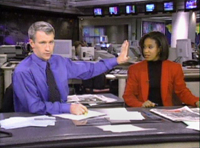
Read more here. Photo of Cooper saying to his co-anchor in 1997, "talk to the hand!" taken from Wikipedia.

By the way, while I find the phrase "verbal jihad" Shister used quite amusing, can we use jihad to refer to any fight or argument?

From Wikipedia:

Jihad
, sometimes spelled Jawwad, Jahad, Jehad, Jihaad, Jiaad, Djehad, or Cihad, (Arabic: جهاد‎ ǧihād) is an Islamic term, literally meaning struggle in the way of God and is sometimes referred to as the sixth pillar of Islam, although it occupies no official status as such.[1] Within the realms of Islamic jurisprudence, jihad usually refers to military exertion against non-Muslim combatants.[2][3] In broader usage and interpretation, the term has accrued both violent and non-violent meanings. It can refer to striving to live a moral and virtuous life, to spreading and defending Islam, and to fighting injustice and oppression, among other usages.[4]

Jihad is defined here as "striving in the way of God." It also said that "jihad is often used to refer to an armed struggle fought in defense of Islam." In this site, jihad refers to a "holy war or struggle." A more thorough discussion of jihad can be found here.
 
Blog directory