Friday, March 10, 2006
The press fights back; files petition vs govt efforts to stifle media
The petitioners asked the Court of Appeals to prohibit the respondents from "imposing any form of content-based prior restraint on the press, be it formal or informal, direct or in the form of disguised or thinly veiled threats of administrative sanction or criminal prosecution." The petition stressed that "only a court, with its accompanying due process safeguards, may impose content-based prior restraints, when the grounds therefor are duly proved."
Named respondents in the petition are Executive Secretary Eduardo Ermita, Department of Justice secretary Raul Gonzalez, Philippine National Police Chief Director General Arturo Lomibao, and National Telecommunications Commission Chairman Ronald Solis.
Aside from CMFR, media groups that signed the petition are:
Philippine Press Institute, National Union of Journalists of the Philippines, Philippine Center for Investigative Journalism, Center for Community Journalism and Development, Newsbreak magazine, Probe Productions, and ABS-CBN News and Public Affairs.
Among the journalists who also signed the petition are Chit Estella, editor of the PJR Reports; Sheila Coronel of PCIJ; Maria Ressa, Vice-President for News and Current Affairs of ABS-CBN Broadcasting Network; Jessica Soho, Vice President for News and News Director of GMA-7; Tina Monzon-Palma of ABS-CBN News Channel (who is also a CMFR board member); Marites Vitug of Newsbreak, Ed Lingao, Vice President for Operations of ABC-5; Ricky Carandang of ANC and Arnold Clavio of GMA-7 and dzBB.
In a press conference at Newsdesk today, the petitioners released a statement to the media.
Journalists file petition against government efforts to stifle media
For the first time since martial law, a broad range of media organizations and journalists have banded together to file a petition in court, questioning government efforts to restrain media reporting and intimidate journalists.
In a petition filed on March 8, 36 print and broadcast journalists and nine media groups led by the Philippine Press Institute (PPI), the national organization of newspaper publishers, the National Union of Journalists of the Philippines and the News and Current Affairs division of network giant ABS-CBN, asked the Court of Appeals to prohibit executive-branch officials from censoring the media.
These officials, the petition said, acted beyond their authority and violated the free-press guarantee in the Bill of Rights by imposing content-based prior restraints on the press. The petitioners therefore asked the court for a temporary restraining order and an injunction that would stop these officials from imposing or threatening to impose such restraints.
In the petition, the media groups asserted that “only a court, with its accompanying due process safeguards, may impose content-based prior restraints.” They specifically cited Executive Secretary Eduardo Ermita, the heads of the Philippine National Police (PNP), the Department of Justice (DOJ), and the National Telecommunications Commission (NTC) for attempts to stop, ban or censor the publication or airing of speech that allegedly incites or tends to incite to sedition.
The media groups also asked the court to prohibit the heads of these four state agencies and other persons acting under their authority from imposing any prior restraint on media content, whether formal or informal or “in the form of disguised or thinly veiled threats of administrative sanction or criminal prosecution.”
While Philippine journalists have defied the restraints, “the threat of official intervention – in the form of administrative sanction or criminal prosecution – is just as damaging to a free press as the fact of it,” the media petition said.
The petition cited the warnings to the media made by, among others, PNP Chief Arturo Lomibao, who said in a press forum on Feb. 25 that the police may take over newspapers “if they do not follow the standards and the standards are if they will contribute to instability in government.”
More specifically, the media practitioners asked the court to annul NTC circulars that prohibit the broadcast media from airing news and commentary that is “subversive” “tends” to incite to treason, rebellion, or sedition, or which constitute “rebellious/terrorist propaganda, comments, information, interviews and other similar or related materials.”
“The NTC does not have any lawful power, authority or jurisdiction to prohibit these things, much less to judge what is subversive (when the crime of subversion has long been repealed), what merely ‘tends’ to propose or incite sedition or rebellion (whatever that means to the NTC), and what constitutes ‘rebellious/terrorist propaganda, comments and the like (whatever that means to the NTC)’,” the petition said.
The petitioners include the top anchors and news managers of erstwhile network rivals, ABS-CBN and GMA-7, among them, Maria Ressa, Jessica Soho, Arnold Clavio, Ricky Carandang, and Pia Hontiveros.
The other media groups that signed the petition include the multi-awarded Philippine Center for Investigative Journalism, Newsbreak magazine, and the independent TV company, Probe Productions. The Center for Media Freedom and Responsibility and the Center for Community Journalism and Development, media NGOs engaged in media development work, signed as well. So did the College of Mass Communication of the University of the Philippines.
“The dangers of unreviewable administrative sanctions imposing prior restraints on the press are as ancient as dictators, the petition said. “We seek the intervention of this Honorable Court to stop the use of the strong arm of the law to exclude speech protected by the Constitution.”
For questions please refer to:
Jose Torres Jr.
National Union of Journalists of the Philippines
Address: 105-A Scout Castor St., Brgy. Laging Handa, Quezon City
Telefax: 411-7768
Email: nujphil@gmail.com
Website: http://www.nujp.org
Sheila Coronel
Philippine Center for Investigative Journalism
3/F Criselda II Bldg., 107 Scout de Guia St., Quezon City 1104
Tel: 410-4768 to 69 / 929-3117
Fax: 929-3571
Email: pcij@pcij.org
Website: http://www.pcij.org
Rachel Khan
Center for Media Freedom and Responsibility (CMFR)
Address: 2/F Ateneo Professional Schools-Salcedo,
#130 HV dela Costa St.,
Makati City 1227
Tel: 894-1326 / 894-1314 / 840-0903
Telefax: 840-0889
Email: staff@cmfr-phil.org
Website: http://www.cmfr-phil.org
Thursday, March 09, 2006
Hello, Gabby?

What's next, Palace officials calling media organizations to fire journalists not following "standards set by the government"?
A top government official called up an ABS-CBN executive at the height of the Marines standoff at Fort Bonifacio on February 26, asking that the network not to cover the ongoing news event, ABS-CBN News chief Maria Ressa told a Senate inquiry on today.
Ressa told the Senate Committee on Justice and Human Rights that the official talked briefly to the executive, telling him not to air the event. She said ABS-CBN turned down the request of the Palace official.
For a full report of Maria's testimony, click here.
Hmmm. Why wasn't I surprised to learn that?
I suddenly remembered what Manolo Quezon said in a press conference two days after Pres. Gloria Macapagal Arroyo issued Presidential Proclamation 1017 (which was lifted on March 3). "The Achilles heel of media are the owners of publications, TV, and radio stations. So, you have to apply pressure on your owners not to fold. The first thing the Palace does is to talk to the owners," Manolo said.
Was Gabby (the nickname of ABS-CBN's president Eugenio Gabriel Lopez III) the "executive" Maria was talking about? We don't know yet. But the fact that someone from the administration called the network requesting it to stop its coverage on an otherwise legitimate news item is clearly an attempt to stifle media to follow "government standards." I personally watched ANC's coverage, and from what I saw, the coverage was fair and balanced. Sometimes, I even think that ANC is trying too hard to get the government's side on an issue, lest be accused again of having an anti-Arroyo bias. Well, that was just my impression sometimes.
Going back to the issue, I can't stop laughing about how certain officials in MalacaƱang became journalists overnight, threatening the press and giving unsolicited advice on what to cover or not. If the Palace continues this way, they should probably begin teaching journalism courses as a sideline. With Pres. Arroyo as the dean.
Arroyo's war against the "reckless" media is not yet over.
Friday, March 03, 2006
GMA lifts state of emergency; ABC 5 releases position on media clampdown
President Gloria Macapagal Arroyo lifted a week-old state of emergency on Friday, after her security advisers assured her that the threat of a coup has eased.
Shortly before Arroyo made the annnouncement in a nationally televised address, two explosions hit near a police station and a shopping complex in a Manila suburb, but police said no one was hurt.
"I am happy to report that we have dismantled the sabotage efforts," Arroyo said. "I strongly believe that law and order has returned."
Arroyo declared the emergency last Friday to quash a coup plot allegedly involving disgruntled soldiers, communist rebels and civilian backers. On Thursday, the defense, justice and police chiefs said they would recommend lifting the decree because the situation was normalizing.
Click here for more.
-----
Check out similar reports from Inq7 and ABS-CBN News. Pres. Arroyo made the announcement at around 11:30 this morning.
In a later interview in ANC, former Pres. Fidel V. Ramos said he was "gratified" for lifting the state of emergency.
My reaction? Well, it's good to know that the controversial declaration made by Arroyo last week was lifted. But I wonder: How much "chilling" effect did we get from that declaration, even though it has been lifted today? I can't forget the recent incidents on the media following Arroyo's PP 1017 -- the Tribune raid, the hacking of the website of the National Union of Journalists of the Philippines, and the cancellation of Kata Innocencio's public affairs show Diyos at Bayan (which I only learned upon watching the Probe last night).
True, the state of national emergency has been lifted, but how can we be sure that there will be no more threats to or attacks against media organizations and journalists here in the country?
While we ponder about it, here is a statement from ABC 5 on the media situation in the country. Got this from ABC 5 reporter Jove Francisco in his blog post.
ABC 5 News and Public Affairs: A statement
Nuong Setyembre 21, 1972 … idineklara ang Martial Law… ipinasara ni Ferdinand Marcos ang ABC.
Dalawang dekadang pinatahimik ang isa sa pinaka-maimpluwensiyang istasyon nuon ng telebisyon.
Kaya nang muling magbukas ang ABC-5 nuong 1992… sinikap ng ABC News and Public Affairs na ihatid sa inyo ang balita, nang walang labis, walang kulang, nang walang takot at walang kulay.
Trabaho naming na maghatid sa inyo ng impormasyon.
Impormasyon na kailangan ninyo, para makagawa ng mga intelihenteng desisyon, maging sa larangan ng pulitika, ekonomiya, lipunan at sa personal na buhay.
Obligasyon naming ang maging patas at walang kinikilingan. Responsable at walang takot.
Kaya’t nababahala ang ABC News and Public Affairs sa mga babala ng pamahalaan sa media nitong mga nakaraang araw.
Tungkulin ng media ang maging responsible.
Obligasyon naman ng pamahalaan na tiyakin na walang manggigipit sa malayang pamamahayag.
Kung mayruon mang tiwali sa panig ng media, may sapat naming batas para dalhin sila sa hukuman.
Pero walang batas na nagsasabing pwedeng idikta ng pamahalaan sa media kung ano ang mga balitang dapat ilabas, at kung ano ang hindi.
Kung kaya’t, ipagpapatuloy ng ABC News and Public Affairs ang patas at makabuluhang pamamahayag.
Ihahatid pa rin naming ang balita nang walang takot at walang kulay.
Hindi maaring idikta ng pamahalaan, lalu na ng Philippine National Police o anumang ahensya ng gobyerno, kung ano ang dapat ibalita ng isang dyaryo o radio o telebisyon at maging sa internet.
Dahil pagdating sa pamamahayag…
Wala silang sapat na kaalaman…
At ayon na rin sa saligang batas….
Wala silang karapatang maki-alam.
Thursday, March 02, 2006
Vague orders from NTC
"Please can someone post the so-called Telecommunications media guidelines that we are supposed to be against? Everybody is talking about how they violate media freedom but if we don't know what they are, we cannot really analyse them and see how it relates to the internationally set standards on freedom of expression. It's like condemning Proc. 1017 and GO 5 without having read them."
Here is a post from the Philippine Center for Investigative Journalism (PCIJ) blog reporting about the reissuance of National Telecommunications Commission (NTC) circulars prohibiting broadcast stations from airing material that "tends to incite to sedition, rebellion or treason and uses language that is 'indecent or immoral.'"
The main problem of these circulars is: How do you define which materials incite people to rebel or which are seditious or not? How should media follow these guidelines while still keeping in mind the values of the profession, such as objectivity, balace, fairness, accuracy, among others? How do you cover, for example, legitimate news sources such as personalities and groups calling for the ouster of Pres. Gloria Macapagal Arroyo?
Here is the NTC's Memorandum Circular No. 01-01-01, which was issued on Jan. 2001 and reissued after the government issued Presidential Proclamation no. 1017:
WHEREAS, the National Telecommunications Commission has received sufficient and reliable information form the Office of the Press Secretary of suspicious elements who are out to create a destabilization move against the duly constituted government;
WHEREAS, radio broadcasting and television station are duty bound to provide adequate public service which include among others, airing of fair and balanced reporting;
WHEREAS, in the interest of justice and fair play and all laws in connection therewith such as radio broadcasting and television stations; franchises and authorities, Memorandum Circular No. 11-12-85 is hereby reiterated as follows:
"5" All radio broadcasting and television stations shall provide adequate public service time; shall conform to the ethics of honest enterprise; and shall not use its stations for the broadcasting and/or telecasting of obscene or indecent language, speech, play, act or scene, or for the dissemination of false information or willful misrepresentation, or to the detriment of the public health or to incite, encourage or assist in subversive or treasonable acts.
"6" All radio broadcasting and television stations shall, during any broadcast or telecast, cut off from the air the speech, play, act or scene or other matter being broadcast and/or telecast, if the tendency thereof is to propose and/or incite treason, rebellion or treason, or language used therein or the theme thereof is indecent or immoral.
In addition, the airing of rebellious/terrorist propaganda, comments, interviews, information and other similar and/or related materials shall be prohibited. (highlighted text Bryanton Post's)
All broadcast media entities, radio or television must conform with the abovementioned guidelines.
17 January, Quezon City, Philippines
(Sgd.)
Nestor C. Dacanay
Deputy Commissioner
(Officer-in-charge)
(Sgd.)
Aurelio M. Umali
Deputy Commissioner
In reaction to these circulars, the Kapisanan ng mga Brodkaster ng Pilipinas, the national association of the broadcaster of the Philippines, released this statement:
In view of the prevailing state of affairs affecting our country and in order not to unduly alarm the public, the KBP leadership enjoins its members to strictly observe the KBP Television and Radio Codes that require balanced programming and presentation of news and public affairs. Coverage of events should be accurate, informative, adequate and must present all sides. The “right to respond” must be observed at all times.
Attention is called to the provision of the KBP Television and Radio Codes that states that rallies and demonstrations are legitimate news events and may be covered at the discretion of the station. However, care must be exercised that the coverage does not provide false information that leads to incite the public to rebellion.
In the coverage of troop movements, members are reminded that there are national security implications and lives are at stake. Any coverage of this nature should NOT identify the location of the troops or provide/show identifiable landmarks, give troop estimates, identity of troop personnel and destination or direction of troops.
In a dialogue with the NTC Commissioners, the KBP was assured that the NTC respects the freedom of the press and of free speech and expression protected by the Constitution. Further, the NTC Commissioners stated that in the enforcement of the laws, rules and regulations affecting broadcast, due process will always be observed in tandem with the self-regulatory mechanisms of the KBP. The Commission further committed to a continuous dialogue with the KBP on matters affecting the industry.
(Sgd.)
Ruperto S. Nicdao Jr.
Chairman
(Sgd.)
Butch Canoy
President
Wednesday, March 01, 2006
What should you do in case you get arrested or harassed
The primer talks about the powers the President may employ under an emergency situation, the nature of lawful and unlawful arrests, and some guidelines on what one should do once he or gets arrested, among other things.
You could download a PDF version of the primer here or here.
Aside from offering the FLAG primer, the National Union of Journalists of the Philippines has also listed some similar tips in its blog.
Either you have press freedom or you don't -- Sun.Star Cebu
Pooled editorial: Media control won’t work
Proclamation 1017 declaring a state of emergency in the country has been described as a harmless weapon that should not instill fear among the law-abiding.
We disagree. It is a lethal weapon in the hands of those who exceed or abuse the power — out of ignorance, spite, or meanness.
Implementors of martial law were guilty of excess or abuse. Enforcers of 1017 are showing signs they don’t know what they are getting into or are bent to exploit it.
The case of police and media is a striking example.
Standards
Last Saturday, PNP Director General Arturo Lomibao said police “would take over” any media outlet that violates “standards set by the Government.”
The standards, he said, are writings or broadcasts that “contribute to national instability.”
The other day, PNP Cebu province police chief Eduardo Gador said media must be balanced in reporting and programming and must not endanger national security, or police “would take over.”
Gador took the cue from Lomibao, as police chiefs in other areas must have also done.
Evaluators
Who will evaluate a news medium? Cops, for heaven’s sake, who are probably good at catching criminals but not detecting flaws in reporting.
They can’t do it. They will botch the job, as then president Ferdinand Marcos saw in martial law’s early stage. (Marcos quickly turned to self-censorship and corruption, which were also destructive.)
Why do cops make poor evaluators? They don’t know the craft and its nuances. Their mind-set is that of victims, whipped frequently by media for lapses and offenses.
Even with media experts among evaluators, assessments will be tricky. How much criticism contributes to “destabilization”? Does one stay out of danger by balancing content in favor of the Government?
Press freedom is enshrined in the Constitution and Supreme Court rulings because government control defeats framers’ intent and freedom’s purpose.
And because the glass cannot be half-full: either there is press freedom or not.
Muzzling press
The Government cannot claim to be free and democratic when it gags media by threats of takeover or shutdown.
Sun.Star newspapers abhor sedition or anarchy to topple a government.
Sun.Star has always advocated for rule of law and orderly transfer of power. But always too, Sun.Star has condemned and resisted muzzling of the press, in whatever form or guise.
NUJP website shut down by hackers
The National Union of Journalists of the Philippines today reports:
The NUJP expresses concern over the shutting down of its website today, March 1. The site could not be accessed practically the whole day Wednesday after somebody hacked into its database server and tried to delete or change files.
According to the NUJP's web host, the hacker or hackers also illegally made too many connections to the database that prevented other users or readers from accessing the site. (The site was up by late afternoon Wednesday.)
The website has been publishing statements, manifestos and updates condemning the latest crackdown by the government on the Philippine press. It also serves as a database of the numerous attacks and murders of journalists in the Philippines. Many journalists and citizens from around the world refer to the site for materials on press freedom in the
Philippines.
In view of the attempts by the Arroyo administration to muzzle or intimidate the press through Proclamation 1017, which the NUJP deems inimical to press freedom, to civil liberties and to the public interest, preventing us from publishing our website is distressing, to say the least. This is no different from forcibly closing down a publication.
The government must stop trying to intimidate journalists. We urge our colleagues in the press to defy Proclamation 1017 and resist the efforts by this government to violate our basic freedoms.
No arguments needed to justify press freedom - Samahang Plaridel
Here is the statement from Samahang Plaridel, which is composed of senior journalists, on what is happening today:
It’s a travesty on our history that we have to argue the inviolability of the freedom of speech and expression, familiarly known as the Freedom of the Press, in a free, democratic, and open society.
In the 19th century, Jose Rizal, Marcelo del Pilar (Plaridel). Graciano Lopez Jaena, and other illustrious Filipinos exiled themselves, formed the Propaganda Movement, published La Solidarida, fought as writers, forbears of journalists, for Filipino freedom. Inherent in the struggle is the freedom of the press.
In the 12 years of martial rule, Filipino journalists along with the freedom-fighters wrote, again in exile, while those who remained in the country did so clandestinely – as virtual exiles.
Today, Proclamation 1017 patently exiles journalists through censorship and in doing so banishes in exile the bedrock liberty of a democratic society.
The government’s imposition of "standards", intimidating sectors in media into asking for "guidelines" from government, is without precedent in a democracy. It is not even sanctioned by our Constitution, which provides that even under Martial Law, civil liberties will be respected.
History clearly shows that civil liberties are irreparably impaired without press freedom.
History shows that a free and independent press is a conservative rather than a disruptive force of a free society. The press does not subvert but instead promotes democracy, that by freely reporting on events and freely and vigorously commenting on them, a free people is able to protect itself from the inevitable abuse of power. A free press is the people’s defense against deception, intimidation, and subjugation from forces inimical to their welfare.
Only in despotic regimes is a free press considered a subversive force, for it is subversive of the arbitrary exercise of power, subversive of conditions that "exalts the few over the degradation of the many," subversive of the despotism of armed duplicity.
Let lawyers and constitutionalists argue the legal merits of Proclamation 1017.
We in PLARIDEL need no arguments to justify the freedom of the press. We find it degrading o have to argue for a sacrosanct freedom that is the shining mark of civil society and the one guarantor of every man’s life, liberty and the pursuit of happiness. A government, nay, a free society that cannot see this has already enslaved itself.
We are informed by the PNP that they are reading all the newspapers and are "evaluating" what we are writing, as if policemen have brains enough to understand the minds of reporters, editors, photographers, cartoonists and columnists. As for the radio and television stations, the one doing the "evaluating" is the National Telecommunications Commission (NTC).
What will befall the newspaper or the radio or television station were we to fail the "evaluation"? The threat is that the newspaper or broadcast station could be closed down. Thus, even the most principled journalist has a Damocles sword hanging over him. One may not care one whit what happens to himself as a person as long as he can continue to be a principled journalist.
There are, however, so many others – jobs and persons- to consider. If a media outlet is closed down – no matter that this is in contravention of all that is sacred to us, including our Constitution – a lot of people who work as technicians, lay-out artists, circulation personnel, typesetters, transmitter personnel, cameramen and others automatically lose their livelihood.
Thus, there is pressure on journalists – whether in print or broadcast – to toe the line, to make an effort to pass the "evaluating" by lesser persons who are cretins when compared to those that they would "evaluate."
While we took our chances during martial law, even to violating presidential decrees almost on a daily basis, there seems no point in taking chances today. After all, under Marcos, martial law was a serious matter, taken seriously by all of us.
Today, we all know that all the State of Emergency is out to achieve is to stop the truth – on already so many subjects – from fully revealing itself. It is a lost battle, of course, since it is in the nature of truth that it will surely reveal itself. She can, perhaps, delay this until 2010 and perhaps beyond but truth will out, eventually if not sooner.
A State of Emergency has been declared when the only emergency is that caused by the continuing rule of incompetents who have no concept of how to run a bureaucracy in a democratic environment. Thus, they become despots, which is, sadly, all that they can hope to be. And, they will not even be good even at being despots.
Edmund Burke is quoted to have said: "Three Estates in Parliament; but in the Reporters’ Gallery yonder, there sat a Fourth estate more important far than they all".
"The basis of our governments being the opinion of the people, the very first object should be to keep that right; and were it left to me to decide whether we should have a government without newspapers or newspapers without a government, I should not hesitate a moment to prefer the latter. But I should mean that every man should receive those papers and be capable of reading them." –Thomas Jefferson to Edward Carrington, 1787.
PPI laments attempts to curb press freedom
The Philippine Press Institute views with grave concern attempts to curtail press freedom following President Gloria Macapagal Arroyo’s declaration of a state of national emergency.A newpaper’s editorial office and printing press have been raided for offenses that authorities have not deigned to make public or explain. Warnings have been issued against violations of “standards” that are shrouded in obfuscation and mystery.
“No law shall be passed abridging the freedom of the press, ” the Constitution says. Where no law can trespass through the front door, no proclamation, decree, order or directive should intrude via the backdoor in the guise of preserving law and order as well as security.
The State is trampling on grounds protected by the Constitution and hallowed by tradition. The exercise of emergency powers does not suspend the Bill of Rights. Prior restraint on the press is anathema to a democratic way of life.
That no newspaper has been closed down and no journalist has been hauled off to jail do not make the assaults on the press any less repugnant.
The intent is to intimidate.
The Philippine press has a long tradition of resistance to tyranny. We refuse to be cowed. The press should not yield an inch of ground.
The PPI, thus, calls on all media organizations to expose and to resist any State attempt to limit their exercise of press freedom.
The PPI also commits itself in solidarity with all sectors resisting the creeping return to the dark days of repression.
(The statement of the Philippine Press Institute adopted during its regular board meeting on March 1, 2006.)
Tuesday, February 28, 2006
UP law faculty and student council fights 1017
Defend our civil liberties and fight for freedom!
Oppose Proclamation No. 1017!
Declaration of the University Council (UC) of the University of the Philippines (UP) in Diliman, Quezon City on Proclamation No. 1017
28 February 2006
A university in a democracy draws its life from an environment of political freedom. None of its basic functions – the quest for truth, the encouragement of critical inquiry, the stimulation of the imagination – is possible in a climate of repression.
The University of the Philippines (UP) as the national university is the vanguard in upholding civil liberties and fighting for freedom. We affirm UP’s commitment to the fundamental constitutional and human rights of the people.
- UPD remains an open space for public debate consistent with its treasured value of academic freedom;
- UPD is a refuge for those who are subjected to political arrests and other forms of harassment;
- UPD challenges every move to clamp down on any of our basic freedoms;
- UPD reiterates its call for Gloria Macapagal-Arroyo to resign; and
- UPD supports a peaceful transition in the political leadership.
STATEMENT OF THE UP FACULTY OF LAW ON PROCLAMATION 1017 AND GENERAL ORDER 5
Last Friday, February 24, 2006, Gloria Macapagal-Arroyo issued Presidential Proclamation 1017, declaring state of national emergency. Immediately after, she issued General Order No. 5, directing the chiefs of the Armed Forces of the Philippines (AFP) and the Philippine National Police (PNP) to “immediately carry out necessary and appropriate actions and measures to suppress and prevent acts of terrorism and lawless violence.”
Since then, these two issuances have been used to justify the imposition of severe limitations on – and in certain instances the outright denial of – civil liberties guaranteed and protected under the Bill of Rights, including the freedoms of speech, expression, of the press, and public assembly. Ostensibly on the strength of Proclamation 1017 and General Order No. 5, a general ban on rallies has been imposed, the PNP has raided one newspaper and threatens to take over other media outfits which “fail to conform to government standards,” and numerous persons, including several members of Congress, have been arrested without warrant.
We, the faculty of the University of the Philippines College of Law, speaking with one voice, condemn in the strongest possible terms this brazen assault on essential freedoms. We firmly and unequivocally take the position that Proclamation 1017 and General Order 5, and the manner in which they are being applied by the Executive, constitute an unconstitutional infringement on civil liberties.
We refuse to accept the half-hearted excuse, put forth by some officials in the Arroyo administration, that the two issuances were “not intended” to violate the Bill of Rights. The simple and undeniable fact is that Proclamation 1017 and General Order 5 have been utilized by the PNP and other executive organs to mount a vigorous and unrelenting campaign against perceived critics of the administration, in full and flagrant disregard of the protections enshrined in the Bill of Rights as well as the legal rules of procedure. Equally undeniable is that the President has sanctioned, or at the very least tacitly approved, these actions undertaken by her subordinates, all of whom are fully within her control.
The indisputable truth is that the violations of the Bill of Rights done pursuant to Proclamation 1017 and General Order 5 are acts of the President.
It must be emphasized that nothing in the Constitution can authorize the suspension of the Bill of Rights. Even under a declared state of martial law, which the Arroyo administration repeatedly insists this is not, the Bill of Rights remains fully operative. Thus, the suppression of free speech, the muzzling of the free press, and the prohibition on public assembly sanctioned by the two issuances cannot be constructed as anything other than clearly and unequivocally unconstitutional.
Our civil liberties, particularly the freedom of speech and public assembly are indispensable to our democracy. We cannot allow them to be arbitrarily suppressed. We therefore call for the immediate and unconditional rescission of Proclamation 1017 and General Order 5.
UP CMC: Rescind 1017!
N.B. - This statement titled “Rescind Proclamation No. 1017″ was signed by 124 students, faculty members and administrative staff of the University of the Philippines College of Mass Communication (UP CMC) at its emergency assembly last February 27, 2006.
Statement of the University of the Philippines College of Mass Communication (UP CMC) on the state of national emergency
Proclamation No. 1017 and General Order No. 5, both signed by President Gloria Macapagal-Arroyo last February 24, have been used by the government to quell legitimate dissent as manifested by the arrests of demonstrators and so-called conspirators to bring down the President. We can conclude from the raid on the broadsheet The Daily Tribune and the tight watch by the military on other media agencies that the Macapagal-Arroyo administration is savaging press freedom.
The suppression of mass media agencies and other organizations will continue unless we unite to fight for our rights and to oppose all measures aimed at curtailing our freedoms. As an academic institution, the University of the Philippines College of Mass Communication (UP CMC) is committed to the defense of free expression and press freedom.
We believe that press freedom is the cornerstone of a democratic society. It is crucial in providing the people the information they need to form enlightened opinion on matters of public interest especially in times of crisis. And yet, Proclamation No. 1017 condemns the media for “recklessly magnify(ing)” the claims of the political opposition.
The UP CMC is committed to oppose measures like Proclamation No. 1017 which clearly undermine the role of the free press in the country.
We demand that the President end the assault on press freedom and the media and immediately rescind Proclamation No. 1017.
1017 attacks the media
MANILA, Philippines – Exactly twenty years after the restoration of democracy and press freedom in the country, local media was again under threat shortly after President Gloria Macapagal-Arroyo declared a state of national emergency via Presidential Proclamation 1017 (PP1017) early in the morning of 24 February.
Several hours after the declaration of PP1017, elements of the Philippine National Police (PNP) swooped down the offices of oppositionist national newspaper The Daily Tribune along T.M. Kalaw Street here around 12:30 am Saturday (25 February).The policemen, who came from the Criminal Investigation and Detection Group (CIDG) and numbering about 15, took mock-up copies of the newspaper’s Saturday edition—which bannered Arroyo’s declaration—as well as several story drafts and photos.
Inspector Jonathan Pablito of the Police Community Relations Group based at the PNP’s headquarters in Camp Crame, Quezon City later confirmed that they were tasked to secure the Tribune offices “because it was a possible source of destabilization materials.” Pablito clarified however, that they were ordered not to impede the work of the publication’s editorial staff and reporters.
Several staffers of Tribune said they were able to go to work as usual during the past weekend, although they admitted being distracted by the presence of the police.
Policemen from the national headquarters remained stationed inside the editorial and business offices of the Tribune, while operatives from the Manila Police District have been posted outside the building. Several law enforcers were also seen surrounding the premises of another pro-opposition newspaper, Malaya, and its sister publication, the tabloid Abante, reports said.
Presidential Chief of Staff Mike Defensor stressed that the government has not taken over the Tribune, but added that the “strong presence” of the police in the editorial offices of the newspaper will remain, to caution other media organizations not to aid those who want to overthrow the government.
In meetings with police officials, Defensor said it was agreed that the government would not interfere with the stories that the paper would put out.
The Tribune has been consistently publishing reports critical of the Arroyo administration. Leading to its temporary seizure by the police early Saturday, the said publication released stories that several disgruntled military and leftist were forming up to mount a coup against Arroyo.
Arroyo declared PP1017 primarily to quell a rebellion allegedly instigated by renegade military officers, supported by civilian supporters and leftist groups wanting to topple the government. Arroyo is facing serious charges of election fraud, allegedly incurred in 2004.
Under this emergency state, the government has the power to take over media facilities whose operations are deemed a risk to national security, Defensor claimed. PP1017 specifically invokes Section 17, Article 12 of the country’s Constitution, which gives the president the power to "temporarily take over or direct the operation of any privately owned public utility or business affected with public interest" in times of national emergency.
In the wake of the raid on the Tribune, Defensor professed the government is currently talking to owners and editors of other media organizations to clarify issues.
In the meantime, military personnel have been stationed outside broadcast network giants, GMA Channel 7 and ABS-CBN Channel 2. According to the government, the military personnel is there “to protect” these media establishments in the event that lawless elements try to take control of them.
Defensor said police presence in media organizations is not a regular state policy. The proclamation, which put the country under a state of emergency, said that some elements of the media are “recklessly” promoting the cause of those who want to overthrow the administration.
Last Friday (24 February), Philippine Daily Inquirer columnist Randy David, lawyer and BusinessWorld columnist Argee Guevarra as well as 35 other militant leaders and academicians, were held by the police for allegedly inciting sedition and leading several hundred of protesters in Epifanio de los Santos Avenue, one of the main thoroughfares in Metro Manila. Guevarra was also the legal counsel of Marine colonel Ariel Querubin, one of the two top military officials charged with planning to lead a botched coup attempt.
On 25 February afternoon, 15 hours after the raid on the Tribune, PNP Director General Arturo Lomibao has warned that the police will take over news groups that will not conform to “standards set by the government.”
This is in accordance with Presidential General Order No. 5 (GO5), directing the country’s armed forces—the military (Armed Forces of the Philippines or AFP) and PNP—to maintain “peace and order and prevent and suppress lawless violence.”
As implied by GO5, reports or publications that hurt the government by “obstructing governance including hindering the growth of the economy and sabotaging the people’s confidence in government” will be subjected to review and possible prohibition, according to Lomibao. GO5 was made in pursuant to PP1017, calling upon the military and police to take direct control of the peace and order in the country.
Lomibao said police will implement standards for media, as a small group of investigators and prosecutors will monitor the news.
Local media sounds the alarm
Tribune publisher and editor in chief NiƱez Cacho-Olivarez said she was tipped off a day earlier that she was on a list of people to be arrested by the government.
"It’s just like (late former dictator Ferdinand) Marcos all over again. It won't be long before they start ringing editors and asking them to fire columnists or writers they consider being against them," Olivarez added, as quoted by the Inquirer online news service.
The raid on Tribune appears to signal the “start of a crackdown on media organizations," according to Newsbreak magazine editor in chief Marites Danguilan-Vitug in a statement to a local online news website.
Vergel Santos, chairman of the board of advisers of the Center for Media Freedom and Responsibility (CMFR) likened Arroyo’s proclamation and the corresponding harassment to media to the tactics used by Marcos during the Martial Law period (1972-81). Marcos was toppled by a peaceful revolt on 25 February 1986, in what has been popularly known as the “Edsa People Power Revolution.”
Santos said media organizations must unite and oppose PP1017 and any effort to suppress press freedom.
In its released statement, CMFR noted that President Corazon Aquino withstood seven coup attempts during her term without having to close down a single newspaper. The press was then left to cover the crises without government guidelines.
“The current attacks against the press are obviously needless, unless these fulfill a larger design to hold absolute unquestioned power,” CMFR added.
In declaring a “state of national emergency,” Arroyo made media among her main targets, the National Union of Journalists in the Philippines (NUJP) said in its official statement.
“That Mrs. Arroyo timed this crackdown on civil liberties with the anniversary of the Marcos dictatorship’s fall only highlights her break with the democratic aspirations of Filipinos,” NUJP added in its statement. “Even as she warns enemies of feeling the full force of the law, Mrs. Arroyo flaunts constitutional guarantees to free speech and expression and press freedom.”
“The role of media is that of serving as a watchdog for exposing social injustice and abuse of power,” Vice president Noli de Castro said in concurrence with reaction of the media groups. “The government may do justice to media by encouraging self-regulation and not repression.”
A former journalist himself, de Castro pointed however, that “if law enforcers believe that a media entity is committing crime against any person or government, then they must immediately enforce the law.”
Earlier, on Friday (24 February) afternoon, the Kapisanan ng mga Brodkaster ng Pilipinas (KBP), a national federation of broadcast media entities, held a dialogue with the government’s National Telecommunications Commission (NTC) to discuss the ramifications of PP1017.
NTC assured the KBP members that it respects the freedom of the press and of free speech and expression as protected by the Constitution. The government’s telecommunications agency also pledged to observe due process in addressing matters affecting the broadcast industry, especially under the present situation.
The national publisher’s union meanwhile, took a more resolute stand in the face of Arroyo’s proclamation.
“Our commitment is to the truth. And while we have the room, however being constricted, nothing will bar us from pursuing our duty,” the Philippine Press Institute said in a public statement.
With reports from the Inquirer News Services
Monday, February 27, 2006
Martial law is here again?
Sheila Coronel writes in the Philippine Center for Investigative Journalism blog:
"The police today forwarded to the Department of Justice two lists containing the names of a total of 59 individuals, including members of leftist party-list groups, leaders of the communist party and renegade soldiers, that it said were guilty of rebellion and insurrection 'committed on February 24, 2006,' the day President Gloria Macapagal-Arroyo announced she had preempted an attempted coup and declared a state of emergency.
"The list, however, does not include Brig. Gen. Danilo Lim, who the military said was a leader of the aborted attempted "withdrawal of support" from the Arroyo government that took place last Friday. Also excluded from the list is Col. Ariel Querubin, the commander of the 1st Marine Brigade, who admitted in yesterday’s standoff at Fort Bonifacio that he had intended to join last Friday’s protests.
"Instead, the lists, contained in two letters sent today by the Philippine National Police (PNP) Directorate for Investigation and Detective Management (DIDM) to Justice Secretary Raul Gonzales, indicates mainly a crackdown on the legal Left and the communist party. And while there were only 59 on these lists, the police also included "others who may be identified later." The PNP letters came with investigation records on the named individuals, who they said were guilty of violations of Articles 134 and 135 of the Revised Penal Code, which penalizes rebellion, insurrection and coup d’etat — all nonbailable offenses punishable with life imprisonment."
(For the rest of the entry, click here.)
Given the intensified crackdown on these so-called destabilizers/coup plotters who allegedly want to overthrow the Arroyo administration, I won't be surprised to see journalists and media organizations being added to the list.
Whoa. It's like martial law all over again.
CMFR's position on President Gloria Macapagal Arroyo's Declaration of a State of National Emergency

The Center also condemns the suppression of democratic rights and liberties committed in its name. The government has announced that it will take over media outlets as necessary. This, together with the raid against The Daily Tribune and the arrest and questioning of columnist (Philippine Daily Inquirer) Randy David, together with 35 other civilians, signal the intent of government to limit the capacity of the press to further investigate and criticize government actions.
The Center warns against the veiled threat of General Order no. 5 against the media. This was followed by the not-so veiled threat of Philippine National Police Director Gen. Arturo Lomibao. He said that PNP would take over any media organization that would not follow “standards set by the government.”
These actions follow up the failure of this administration to take strong steps to stop violence against journalists and media practitioners who work in the community press. In 2005 alone, seven journalists had been killed and no one has been jailed for it.
President Corazon Aquino, who withstood seven coup attempts during her term, never had to close down a single newspaper. The press was left to cover the crises without government guidelines. The current attacks against the press are obviously needless, unless these fulfill a larger design to hold absolute unquestioned power.
Clearly, the actions of President Arroyo reflect her failure to understand and appreciate press freedom as a core value of Philippine society.
We call on all Filipinos to defend press freedom as their right as it is the only way they can get the information they need as citizens of a democracy. This right is protected and preserved by no less than the Philippine Constitution.
CMFR asks its allies around the world to express its solidarity with this cause and to protest most vigorously the current suppression of the free press in the Philippines.
Thursday, February 23, 2006
Why do we blog?
"To paraphrase Kafka," Scanlan writes, "my blog is the ice-axe that broke the frozen sea within me. It has helped me find myself again as a reader and writer. It has set me free."
Check out his reasons for coming up with his blog, "The Mechanic & the Muse," which he stated last January 17.His reasons are almost the same as mine.
Wednesday, February 22, 2006
Covering disasters and catastrophes
Below is a set of guidelines published in the August 1990 issue of the PJR Reports (which was still then known as the Philippine Journalism Review) to help the media in adequately covering such catastrophic events (which we hope to be lesser in the future).
Guidelines for Coverage of Disasters and Catastrophes
- On-site and field reports for radio and television must build on verified facts. Facts of geography, location, population, infrastructure, commerce, and industry flesh out the damage with specific detail.
- Estimates of casualties should be corroborated by various sources. If official counts are available, these should be cited and specifically sourced.
-At the time of the crisis, broadcast reporters need to tone down their delivery, so as not to contribute to public hysteria. Updates and warnings serve the purpose better when issued in a calm and restrained voice.
- Reporters must beef up their stories with research. Orientation about the issues raised by the particular kind of disaster and rescue operations prepares correspondents to observe the procedures more intelligently without interfering with the conduct of operations.
- Reporters must bear in mind that rescue operations take precedence over their story. They cannot interfere with the saving of lives and prevention on injury. They must respect the primary obligation of rescue workers which is to save lives.
- Reporters and photojournalists cannot be too sensitive to the plight of victims and their families and friends. In getting their story or picture, they must respect the victims’ desire for and right to privacy.
- News directors for radio and TV should aim for balanced coverage with the use of straight news, feature, and human interest stories. The latter two provide the necessary color but cannot take the place of hard information.
- Unconfirmed reports should be handled with care and caution. Completely blind reports must be passed off until verified for accuracy.
- Crisis coverage must be devoid of posturing, playing hero, and other kinds of grandstanding on the part of media. It should also guard against the use of media time or space by those pushing for their individual and personal gains. Such gimmickry can get on the nerves and add to the burden of stress.
- Reporters should prepare a line of questioning for spot interviews. Radio anchors should minimize the chit-chat ordinarily used to project intimacy with listeners or to fill up idle time. The level of triviality can be disturbing and out-of-synch with the gravity of the situation. Hour-on-the-hour formats to cover developments should use well-informed resource persons who can help to promote understanding of the disaster. Such segments can also enrich program material by expanding the cast of personalities and voices.
Why are we so obsessed with titles? (some wedding jitters)
The affair went well -- except for some incidents which almost made me lose my temper that day. You see, some of the primary sponsors (ninongs and ninangs) are police officials. So, being the program coordinator (15 minutes before the actual wedding), I called out the sponsors for them to get in the line for us to proceed with the wedding procession immediately.In the list, the police officials have their official designation at the start of their names, the most common of which is the title "Police Superintendent." Since I was unsure of the ranks of all these officials (i.e. colonel, general) and I did not want to sound clunky and too formal if I address most of them with the term "Police Superintendent," I began referring to them as either "Mr." or "Ms."
One lady reacted when I addressed someone with that. "Col. XXX 'yan, hindi mister," snorted the woman, whom I later learned as also a police official, although of lower rank. (The colonel whom I addressed as mister, by the way, did not react)
I could have retorted back at the lady, saying something like, "Sorry, thanks for informing that he is a colonel, but isn't he a guy? Addressing him as a "miss" instead would sound silly, right?" But fortunately, I did not.
I told the incident two days later to my cousin. Well, at least, she sounded sorry for me. But I was surprised when my cousin -- who is currently training to be a member of the police force, -- said: "Intindihin mo na lang. Police character iyon eh. Hindi talaga papayag iyon na tatawagin lang silang mister o miss. Naghirap iyon para makuha iyong ranggo eh."
What followed was a long discussion alright (no, we didn't end up angry at each other), but in sum I reacted that it was not my fault that they have to train hard to become part of the police force and therefore giving them the right to be arrogant and feel superior towards civilians like me. What, should I now know the ranks and police designation of every effing member of the police I know and address them with such?
What's with us Filipinos and our obsession with titles? Do we really need to impose upon everyone the title we have? Is this a sociocultural thing we need to impress upon others of the achievements we made or a validation of how high (or low) we are on the social scale?
What about me? Should I tell everyone that they need to refer to me as "Bryant, the journalist" or whatever position I hold in PJR Reports?
Haay, before I go on a full discussion of the subject here (which I think deserves another post), here's a link on my photo album to my cousin's wedding.
Monday, February 20, 2006
Shigi shigi

Are you a Shaider fan? Do you miss the dazzling moves of Alexis, ang Pulis Pangkalawakan, and the repeated but failed attempts of Fuma Ley-ar to destroy him (and not to mention Shaider’s partner Annie in her, well, thought-provoking poses)?
Well, Pulpcommunity’s Tarhata offers Shaider DVDs for the hardcore fans of the series (like me). She says she has the complete Shaider collection (a six-CD set) for P450.
If you want to order or have questions, email her at pinkbayawak@yahoo.com. Aside from Shaider, Tarhata also sells films ranging from various genres and movements around the world, such as classics, indies, expressionism, neo-realism, and film noir, among others.
As for me, I’ll order Shaider first before I get my copy of Citizen Kane and The Bicycle Thief from her. Hmmm. Better yet, ask Tarhata if she also has Bioman and Maskman DVDs. That would really make my day.By the way, for those who still do not know, Hiroshi Tsuburaya, the actor who played Alexis in Shaider, died on July 24, 2001 due to liver cancer. He was 37.
Talk about transparency
Stripping away the mystery
By Alexandra Hudson
Amsterdam's famed red light district held its first ever "open day" Saturday as its peep-shows and brothels gave crowds of wide-eyed visitors free entry to help shed the area's increasingly negative reputation.Armed with a list of 25 establishments opening their doors and flinging back their red curtains, hundreds of tourists and locals seized the opportunity to see a prostitute's bedroom, watch a brief live peep-show or chat to a lap dancer.
Click here for more.
Saturday, February 18, 2006
Sorry for the late posting of these pictures

Sorry, Hazel, for posting these late pictures. I'm quite busy these days, that's why it took me so long to post these pictures.
These were taken from my sister's small informal debut party last Feb. 11 at D' Charcoal Haus in Bulacan. I also have the pictures of my cousin's Joy wedding the next day, but will post them next week. With so many issues that we have to tackle in the March issue of the PJR Reports, I'm having a hard time maintaining my blog. *Sigh* But I promise, as soon as I am finished with the March issue, I'll post again.
Here is the link to Hazel's birthday pics.
Tuesday, February 07, 2006
If you've got nothing to do on Feb. 11, Saturday (unlike me)
presents
Suffocation
featuring performances by..
Valley of Chrome
Machinesledge
Oremus
Eida
18th Issue
Cakewalk
Chaotica
Fingertap
Except Zero
Pedro Lucas III
Sanctus
First Degree
Xycopitch
Carpediem
120php with 1 free beer
8PM
February 11(Saturday)
ALKYS BAR Menlo St. cor. Leveriza St.
(Near Arellano University and La Salle Taft)
Monday, February 06, 2006
Cebu photojourn’s killer gets death

Too bad I wasn't able to post this earlier. Here's an except from a post made by Freedom Watch, the blog of Center for Media Freedom and Responsibility.
Cebu photojourn’s killer gets death
A Cebu judge ordered the death penalty for the convicted killer of Allan Dizon, a photojournalist who worked for The Freeman and Banat News last January 19.
Cebu City Regional Trial Court Branch 5 Judge Ireneo Lee Gako Jr. handed down the death sentence to Edgar Belandres, who was found guilty of slaying Dizon on 27 November 2004. I
Belandres’ lawyer Pedro Salva said they will appeal the conviction. Dizon also reportedly worked as a police asset, which could be the reason behind the killing, as the photographer allegedly tipped off the local police about Belandres’ suspected drug dealing.
Belandres’ conviction was the second successful resolution of journalist-killing cases in Cebu. Just last November, Edgar Wapile, killer of Pagadian City journalist Edgar Damalerio, was convicted to life imprisonment.
Here's the complete post of Freedom Watch while above is the picture of Dizon, taken from Sun.Star.
Tuesday, January 17, 2006
Coming soon: Gloria: The Survivor?
Talk about politicians who find nothing wrong dabbling in showbiz.Thaksin Shinawatra, Thailand's Prime Minister, has started appearing in his own round-the-clock reality TV show.
The show, called the "Backstage Show: The Prime Minister," started airing yesterday. UBC, Thailand's biggest cable operator, will follow the prime minister and air live footage of Thaksin 24 hours a day from January 16 to 21 for his working visit at the northeastern province of Roi Et.
The Nation, one of the country's biggest papers, had this to say about the show's first airing:
"Boring, say many viewers of (Thaksin)’s reality show as locals, protesters mass in Roi Et. Life in At Samat district of Roi Et came to a virtual standstill yesterday as Prime Minister Thaksin Shinawatra arrived to launch his five-day reality show dedicated to fighting poverty." (Read more about the article)
The paper also has a minute-by-minute coverage on the show, which it entitled "Our light hearted look at the Thaksin Fantasia as it happens."
According to this report, Shinawatra "hopes to boost sluggish public support for his government by appearing in his own round-the-clock reality TV..."
I won't get surprised if Pres. Gloria Macapagal Arroyo is thinking of copying what Shinawatra did, given her dismal public performance, at least according to the surveys. So, what's the title gotta be? "The Survivor: Gloria Macapagal Arroyo"? Or should it be the "Amazing Gloria"? How about a Donald Trumps rip-off, "The (Power-hungry) Apprentice?" What do you think?
Friday, January 13, 2006
Aargh
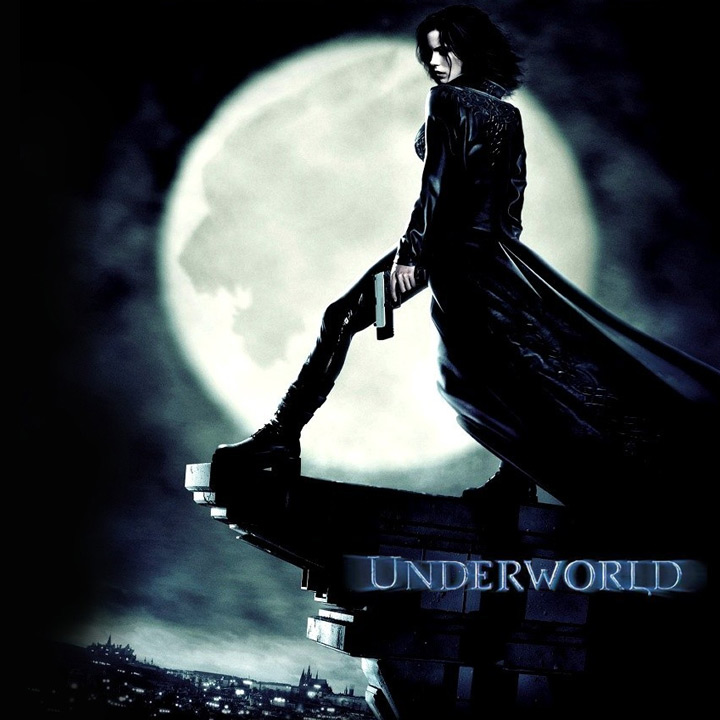
Why do I even bother changing the template of my blog? Sorry about my links (or the lack of it) in my new template. I'll definitely work that out. As soon as the January 2006 issue of the PJR Reports is taken to the press. Sigh.I am currently watching Txtube, a music video show in GMA-7, while researching for the February issue of the PJR Reports. One of the songs of a favorite band, the US-based Finch, was featured at least twice in the show. The song, "Worms of the Earth", was an OST of the 2003 film "Underworld", which starred Kate Beckinsale and Scott Speedman. Haaay, can't wait to see the film's sequel, "Underworld Evolution".
Meanwhile, below is the video of that Finch song. The photo on the left was taken from this site.
Thursday, January 12, 2006
Money, money, money
The Picto-Personality Test![]() When alone, you appreciate being able to do nothing if you want to, and setting your own pace for things. You are adventurous, always up to do the most extreme things. You have a certain recklessness that makes people very attracted to you. In the future you will be very wealthy. You have the ambition and the drive to make a lot of money. |
| Take this Test at QuizGalaxy.com |
How I wish this is true. I mean, the money part.
Thursday, January 05, 2006
PCIJ's take on the journalist killings
Check her post.
2005, the deadliest year in a decade for media -- RSF
On the Philippine situation, RSF said: "In the Philippines too, journalists were killed while trying to inform the public. Their enemies were no longer armed groups but politicians, businessmen and drug-traffickers ready to silence journalists who exposed their crimes. Despite the conviction during the year of the killer of journalist Edgar Damalerio, murdered in 2002 on the island of Mindanao, impunity remained the rule."
Read more of RSF's annual roundup.The photo on the left was taken from a pdf file of the roundup.
Wednesday, January 04, 2006
The Philippines, still a deadly place for journalists in 2005 -- CPJ
As CPJ noted in its latest analysis of journalist killings around the world, the murders last year were lower compared with the eight recorded in 2004 (CMFR however listed only six killings in 2004).Despite the lower number of journalist killings in the country last year, as well as the conviction of the killer of Pagadian journalist Edgar Damalerio (see CMFR report on the conviction), this does not mean that we should stop being vigilant and monitor any attacks against and threats to the press freedom in the country. As noted in a CMFR study last year on the journalist killings from 2000 to 2005, “the threat to press freedom and the danger to journalists will continue for as long as a culture of impunity remains.”
Here is CPJ’s latest analysis of the killings worldwide. The Philippines was the deadliest place for journalists in 2005, next to Iraq, CPJ said in its analysis.Thanks to the Toronto-based press freedom network International Freedom of Expression Exchange for posting CPJ’s analysis in their website.
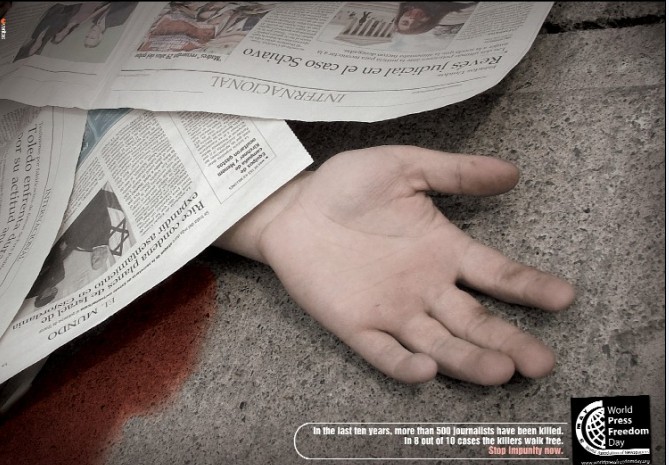
By the way, the photo above, which highlighted the high number of journalist killings in 2004, was an advertising material taken from the World Press Freedom Day website.
From Iraq to the Philippines, murder is top cause of journalist deaths in '05
Death toll is 47 worldwide; Iraq becomes deadliest recent conflict
Kidnappers in Iraq, political assassins in Beirut, and hit men in the Philippines made murder the leading cause of work-related deaths among journalists worldwide in 2005, a new analysis by the Committee to Protect Journalists (CPJ) shows. Forty-seven journalists were killed in 2005, more than three-quarters of whom were murdered to silence their criticism or punish them for their work, CPJ's annual survey found. That compares with 57 deaths in 2004, just under two-thirds of which were murders.
Iraq, the most dangerous place for journalists in 2005, also became the deadliest conflict for the media in CPJ's 24-year history. A total of 60 journalists have been killed on duty in Iraq from the beginning of the U.S.-led invasion in March 2003 through the end of 2005. The toll surpasses the 58 journalists killed in the Algerian conflict from 1993 to 1996.
CPJ's analysis also documented a long-term trend - those who murder journalists usually go unpunished. Slayings were carried out with impunity about 90 percent of the time in 2005, a figure consistent with data collected by CPJ over more than a decade. Less than 15 percent of journalist murders since 1992 have resulted in the arrest and prosecution of those who ordered the killings.
A complete list of journalists killed, along with details about each case, is available at: http://www.cpj.org/killed/killed05.html
Although the 2005 toll reflected a decline from the previous year, it was still well above the annual average of 34 deaths that CPJ has documented over the past 10 years. In fact, 104 journalists were killed in 2004 and 2005, making it the deadliest two-year period since the war in Algeria raged a decade ago.
"Too many journalists have lost their lives just because they were doing their jobs, and unresponsive governments bear responsibility for the toll," CPJ Executive Director Ann Cooper said.
"The war in Iraq might lead one to think that reporters are losing their lives on the battlefield. But the fact is that three out of four journalists killed around the world are singled out for murder, and their killers are rarely brought to justice. It's a terrible indictment of governments that let warlords and criminals dictate the news their citizens can see and hear."
Iraq accounted for 22 deaths in 2005, or nearly half of the year's total, CPJ found. Yet even in that conflict zone, murder accounted for more than 70 percent of the deaths documented by CPJ. The prevalence of targeted killings reflected the evolving threat in Iraq, where crossfire had been the leading cause of death the previous two years. Fatal abductions emerged as a particularly disturbing trend as at least eight journalists were kidnapped and slain in 2005, compared with one fatal abduction the previous year.
Iraqi journalists bore the brunt of these attacks as it became increasingly hazardous for foreign reporters and photojournalists to work in the field. American freelancer Steven Vincent was the only foreign journalist to be killed in Iraq in 2005; five foreigners died there a year earlier.
At least three journalists were killed as a result of fire from U.S. forces, compared with six such deaths in 2004. U.S. forces' fire has killed 13 journalists between March 2003 and the end of 2005. An analysis of casualties in Iraq is available at:
http://www.cpj.org/Briefings/Iraq/Iraq_danger.html
The Philippines, where outspoken radio journalists have been murdered in alarming numbers, was the second deadliest place in 2005. CPJ documented four murders in the Philippines, a decline from the eight recorded in 2004. The drop was due in part to more concerted national law enforcement, CPJ's analysis found.
Six countries recorded two deaths each in 2005. Prominent Lebanese columnists Samir Qassir and Gebran Tueni - both of whom were well-known for their biting criticism of the Syrian government and its influence over Lebanon - were killed in separate car bombings in Beirut. A third Lebanese journalist was maimed in another car bombing. The other countries with two killings were Russia, Bangladesh, Pakistan, Sri Lanka, and Somalia.
The Americas showed a marked improvement with four confirmed deaths in 2005, down from eight a year earlier. But many journalists in the region attributed the drop to increased self-censorship, a phenomenon that CPJ found prevalent in Colombia and Mexico.
Two journalists went missing in 2005 - Alfredo JimƩnez Mota in Mexico and Elyuddin Telaumbanua in Indonesia. Details about missing journalists are available at: http://www.cpj.org/Briefings/missing_list.html
CPJ considers a journalist to be killed on duty if the person died as a result of a hostile action, including retaliation for his or her work; in crossfire while covering war; or while reporting in dangerous circumstances such as a violent street demonstration.
CPJ continues to investigate the cases of 11 other journalists killed in 2005 to determine whether the deaths were work-related. CPJ staff has compiled detailed information on journalists killed around the world since 1992. Statistical information and case capsules are available at: http://www.cpj.org/killed/killed_archives/stats.html
KEY POINTS in 2005:
a. Forty-seven journalists were killed worldwide in 2005. Of those, 37 (or 79 percent) were murdered. Five journalists died in crossfire during war and another five as a result of dangerous assignments.
b. The war in Iraq accounted for 22 deaths overall. Of the deaths in Iraq, 16 (or 73 percent) were murders.
c. At least eight journalists in Iraq were abducted before they were executed. There was only one such case in 2004.
d. Twenty-one of the 22 journalists killed in Iraq were Iraqis. The only foreigner killed in Iraq was American Steven Vincent.
e. Sixty journalists have been killed in Iraq since the U.S.-led invasion began in March 2003, surpassing the 58 killed during the Algerian war from 1993 to 1996.
f. The Philippines ranked second in deaths worldwide in 2005 with four, a 50 percent drop from the previous year.
g. Two prominent Lebanese columnists critical of the Syrian government were killed in Beirut, both in car bombings.
h. Deaths in the Americas dropped to four from the eight recorded in 2004. Some journalists attributed this to self-censorship, particularly in Colombia and Mexico.
Saturday, December 17, 2005
Mona Lisa smile secrets revealed

So, Mona Lisa was really smiling after all.
Latest research findings show that Mona Lisa was 83 percent happy, 9 percent disgusted, 6 percent fearful, and 2 percent angry.
Below is a CNN report on the findings.
Computer decodes Mona Lisa's smile
(CNN) -- Scientists analyzed the portrait of the Mona Lisa, a woman with famously mixed emotions, hoping to unlock her smile. They applied emotion recognition software that measures a person's mood by examining features such as the curve of the lips and the crinkles around the eyes.
The findings? Mona Lisa was 83 percent happy, 9 percent disgusted, 6 percent fearful, and 2 percent angry, according to the British weekly New Scientist.
Still, scientists will probably never know what made her feel the way she did.
The computer software, developed by Nicu Sebe at the University of Amsterdam and researchers at the University of Illinois, examines key facial features, the journal reports.
Sebe loaded average, neutral expressions of female faces into a database, which the software used to compare the painting against, says the "New Scientist" Web site.
Leonardo Da Vinci's masterpiece is housed at the Louvre, in Paris, France, and is the museum's top draw.
The Mona Lisa -- called La Gioconda in Italian and La Joconde in French -- has captivated and mystified the art world for centuries.
The portrait was painted in Florence, Italy, between 1503 and 1506, according to the Louvre's Web site.
Historians have long debated Mona Lisa's identity, with theories ranging from being Da Vinci's mother, a self-portrait or a Florentine prostitute.
Research conducted in 2004 support a claim first made almost 500 years ago -- that she really existed and that she was the wife of a rich silk merchant.
The Mona Lisa is featured in author Dan Brown's best-selling novel The Da Vinci Code.
I know that the Philippine Daily Inquirer made a report on this study last December 16, but I couldn't find a link of the report.
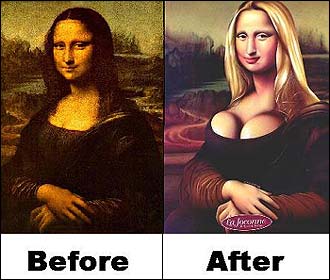
By the way, would Mona Lisa still smile when she sees what she would look like after a week's travel to the United States? Got this from an Italian site. Whoa.
Thursday, December 15, 2005
Year of Pinoy Blogs
And now, coup rumors are again in rife in the country's capital. With today's arrest of former defense secretary Ret. Gen. Fortunato Abat who yesterday called for a revolutionary transition government, I wonder how our December would be.
What a year of political scandals, this 2005.
This year also marks significant changes on other fronts, including on the media. In an article published in the November issue of the PJR Reports (formerly the Philippine Journalism Review), I wrote how this year would be known as "The Year of Filipino Blogs," with blog sites complementing (sometimes even scooping up) traditional news media in reporting news and information to the public
Year of Pinoy blogs
By Hector Bryant L. Macale
Thanks to the “Hello, Garci” tape scandal, journalists joining the community of Filipino bloggers have been increasing. And so are the questions about this latest powerful medium for free expression.
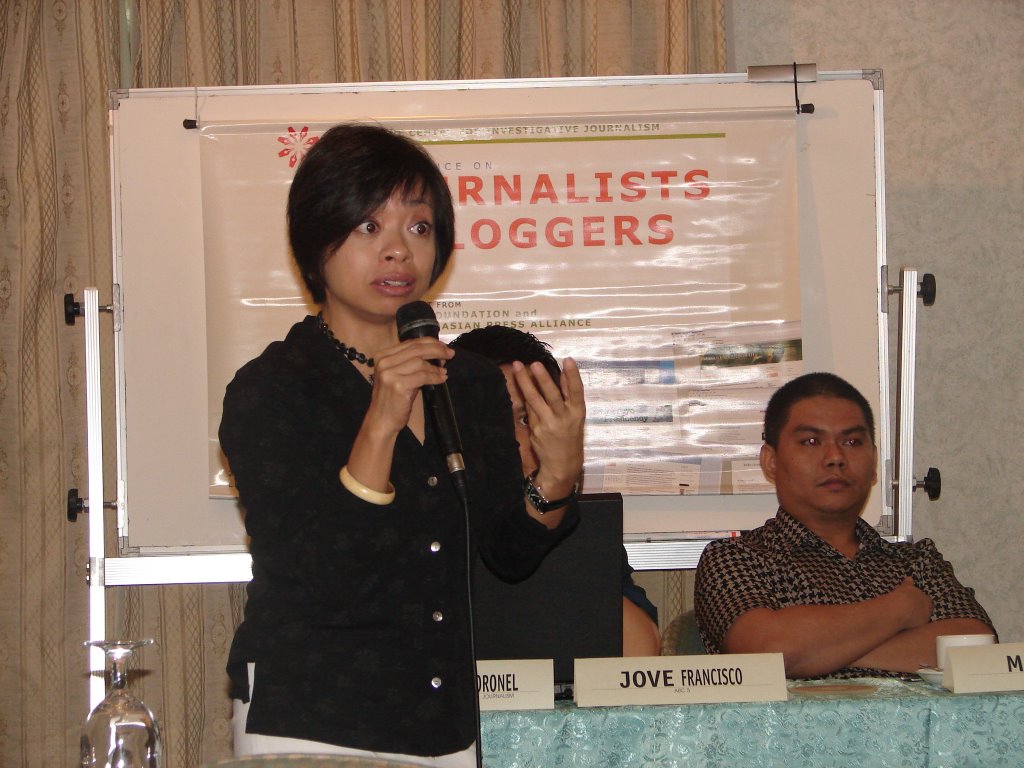
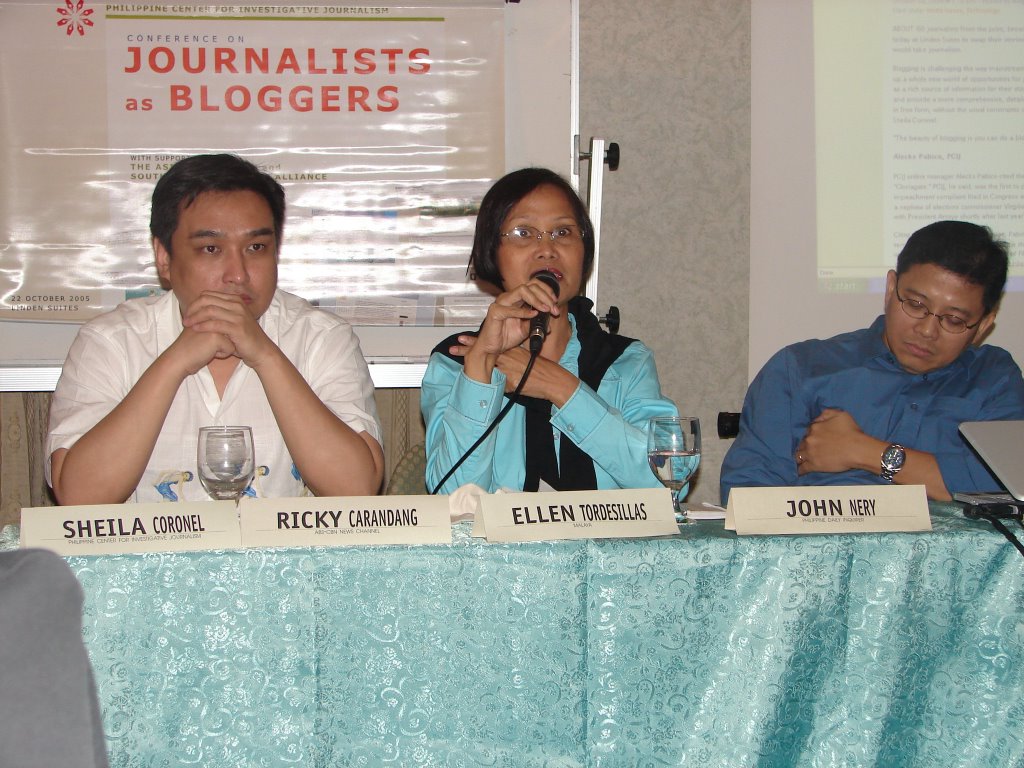
In a conference organized by the Philippine Center for Investigative Journalism (PCIJ) last October 22, at least 50 journalists discussed the potentials and pitfalls of blogging. The forum, also supported by The Asia Foundation and the regional press freedom alliance Southeast Asian Press Alliance (SEAPA), looked into the legal issues and the opportunities for the press because of blogging.
"The beauty of blogging is you can do a blow-by-blow account," PCIJ executive director Sheila Coronel said at the start of the conference.Coronel’s assessment was based on the PCIJ’s recent experience with its institutional blog, “Inside PCIJ,” which played a big role in the unraveling of the “Hello, Garci” scandal. “Inside PCIJ” provided in-depth reports and up-to-date account of events, sometimes ahead of most media outfits. It was the first to post online audio files and transcripts of the alleged conversations between President Gloria Macapagal-Arroyo and former elections commissioner Virgilio Garcillano. The PCIJ blog registered almost 500,000 unique hits in June, when it started the daily coverage of the “Hello, Garci” scandal.
Instant feedback
Alecks P. Pabico, PCIJ online manager, called 2005 as "the year of Filipino blogs" because of the rapid increase of journalists and non-journalists who went into blogging following the political crisis. These blogs posted a wide range of topics from personal accounts and views to institutional concerns (such as “Inside PCIJ” and the Center for Media Freedom and Responsibility’s “Freedom Watch”) to experiments in citizen journalism (Sun.Star’s “Citizen Watch”).
According to Max Limpag, who is in charge of the Sun.Star Cebu website, the blog is easier to manage than the website. Citing the experience of SunStar Cebu’s “Arroyo Watch” blog at the height of the “Hello, Garci” scandal, Limpag said feedback from readers were immediate.
With the success of the “Arroyo Watch,” Sun.Star created the “Citizen Journalism” blog which encouraged readers to post articles rather than not just send comments.
During the forum, ABC-5 reporter Jove Francisco said he was attracted to blogging because it “offers something that is not available in the industry.” A MalacaƱang reporter, Francisco’s “By Jove!” blog regularly posts additional information or details about news in the Palace. “We want to say more of what we know,” he said.
Lawyer-blogger JJ Disini, director of the University of the Philippines Law Internet and Society program, explained how laws on libel, sedition, privacy, and copyright could be applied to blogging.
When copying information or work from other online sites, he said "the less you use (the article) the better off you are." He stressed that using information from other sources is permissible for as long as the source is cited or a source link is provided in the post.
Blogging ethics
For her part, Rachel Khan, a UP journalism professor and deputy director of the Center for Media Freedom and Responsibility (CMFR), reminded bloggers that they are still accountable to the public. She said blog sites become popular only when readers know they can be trusted. Other reasons for a blog’s acceptance are the blogger’s level of niche expertise on a subject or particular field; transparency of motives (or biases); transparency in process (identification of sources); and willingness to take responsibility when mistakes occur.
Khan (shown in the middle with Tina Panganiban Perez on her left and Atty. Disini on her right) advised journalist-bloggers to strictly follow the Bloggers’ Code of Ethics by the CyberJournalist.net, a modification of the code of ethics by the US-based Society of Professional Journalists.But, this early, the Bloggers’ Code of Ethics does not seem good enough for some entities. GMA-7 reporter Tina Panganiban-Perez said there are certain corporate or company guidelines which she and her co-employees must comply with in maintaining their blogs.
According to Perez, the GMA network staff are not allowed to discuss their work in their blogs. She said articles posted in the blog of veteran reporter Howie Severino is edited by GMA. The network hosts Severino’s blog, Sidetrip.
Reacting to Panganiban’s revelations, Francisco and ANC anchor and blogger Ricky Carandang heaved a sigh of relief that their networks have not come up with a similar policy on blogging.
Carandang observed that the impact of blogging on the mainstream press is not that yet significant. "While it’s gaining recognition, it’s not quite there yet," he said.
The Philippine Daily Inquirer’s John Nery agreed with Carandang, at the same time noting that blogs could be used to monitor radio reports. He said many radio reports are not picked up or pursued by other media.Although she has yet to start her own blog, Malaya columnist Ellen Tordesillas has reaped the benefits of blogging. She said blogs have proved to be valuable information sources for her reports. (Just an update: In less than a month after the PCIJ conference, Tita Ellen started her own blog.)
The conference ended with a lively discussion on journalism standards as applied to blogging and a technical session on how to set up a blog.
If there was one thing that clearly stood out from the one-day discussions, it was, blogging is here to stay.
Wednesday, December 07, 2005
Birthday pictures galore

Finally, I am posting the pictures from our small birthday celebration last November 27 (My sister Ivy and I decided to have a single bash almost every year since our birthdays are so close to each other. It’s cheaper too, haha!). More than seventy of the people dearest to us came to the event (which was held in D' Charcoal Haus in Bulacan), excluding the relatives. And my, what a bash. Thanks guys for coming.
Click this link and look for the folder labeled "Bryant's and Ivy's birthday bash 11-27-05" for the pictures.

My cousin, Jhoanna, also celebrated her birthday last November 19. For pictures of her celebration, click this link and look for the folder labeled "Jhoanna's bday bash 11-19-05".